
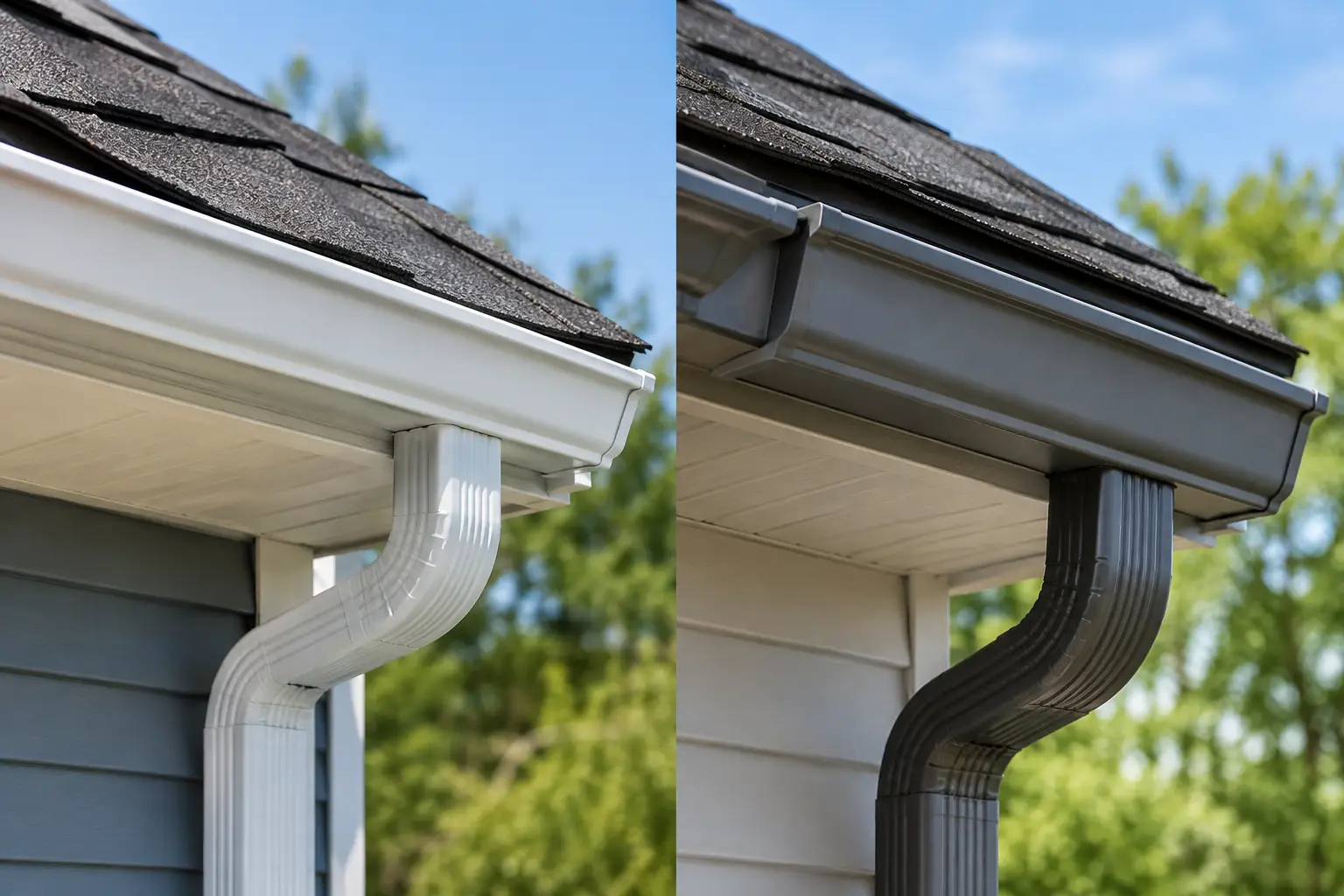
A gutter that handles an ordinary shower can still overflow during a Central Florida downpour. That is why the choice between five versus six inch gutters is not just about appearance or a small difference in size. It affects how well your home moves roof runoff away from fascia boards, landscaping, walls, and the foundation when rain comes down fast.
For many Orlando homes, a properly installed 5-inch seamless K-gutter system is a reliable fit. Others need the added capacity of 6-inch gutters to prevent the repeated overflow that leads to staining, wood rot, washouts, and repair calls. The right answer depends on your roof, drainage layout, and the way water behaves during heavy storms.
Five Versus Six Inch Gutters: The Main Difference
A 5-inch gutter is the common residential standard. It is generally suitable for homes with average roof areas, straightforward rooflines, and properly sized downspouts. It offers a clean, proportionate look on many single-story and two-story homes.
A 6-inch gutter is wider and deeper, giving it more room to collect and carry water before it reaches a downspout. The extra capacity is especially useful when a large section of roof drains to one gutter run or when a valley sends a concentrated rush of water into one spot.
That one-inch difference may not sound significant, but gutter capacity does not increase by only a small amount. A 6-inch K-style gutter can carry substantially more water than a 5-inch system. During a brief, intense storm, that added volume can be the difference between controlled drainage and water spilling over the front edge.
Size alone does not solve every drainage problem. A gutter needs the correct pitch, secure hangers, enough downspouts, and clear outlets to perform as intended. Even a 6-inch system can overflow if it is clogged with leaves or forced to drain too much water through a single undersized downspout.
When 5-Inch Gutters Are a Good Fit
Five-inch seamless gutters remain a practical choice for a large number of Central Florida homes. They work well when the roof has moderate square footage feeding each gutter section and the water is distributed across several runs and downspouts.
They are often a good fit for homes with simple gable roofs, modest eaves, and no major valleys directing water into a single area. If the existing 5-inch gutters have performed well over the years and are only leaking, sagging, or worn out, replacing them with new custom-fit 5-inch seamless gutters may be the most sensible option.
A 5-inch system can also make sense when roof drainage is already well designed. For example, a long gutter run may handle rain effectively if it has appropriately placed downspouts rather than trying to send all runoff to one end. The condition of the fascia matters as well. Strong fascia and correctly spaced hangers help keep the gutter aligned and pitched properly.
Homeowners should not assume that overflow automatically means they need larger gutters. Overflow can come from debris buildup, a loose section, poor slope, a crushed downspout, or splashback where a roof valley hits the gutter. A direct inspection is the best way to separate a maintenance or repair issue from a capacity issue.
When 6-Inch Gutters Make More Sense
Six-inch gutters are often the better choice for homes that collect a high volume of water quickly. Orlando’s summer storms can be short but intense, and larger roofs can produce a heavy flow in only a few minutes.
Consider 6-inch gutters when your home has a large or steep roof plane draining into one run. Steeper roofs shed water faster, which can overwhelm a smaller gutter even if the total roof area is not unusually large. Large two-story homes, homes with expansive rear roof sections, and properties with complicated rooflines commonly benefit from the added capacity.
Roof valleys are another deciding factor. A valley combines runoff from two roof planes and funnels it to one location. If you have seen water shoot past the gutter or spill over near a valley during heavy rain, a 6-inch gutter may be appropriate. In some cases, a larger gutter combined with a properly placed downspout provides a more dependable fix than simply adding a splash guard.
Six-inch gutters are also worth considering when you want a little more margin for heavy rain and seasonal debris. They are not a replacement for cleaning, but the larger opening can be more forgiving when small leaves, seed pods, or roof grit collect between service visits. Homes surrounded by oak trees, palms, or pine trees may also benefit from pairing the system with a quality leaf guard solution.
Downspouts Matter as Much as Gutter Size
The gutter collects water, but the downspout has to move it safely to the ground. A common mistake is installing a larger gutter while leaving too few or too-small downspouts in place. Water can back up in the gutter if it cannot exit quickly enough.
A 5-inch system is commonly paired with smaller downspouts, while 6-inch gutters are frequently matched with larger downspouts that can carry more water. The right combination depends on the roof area that drains into each outlet and the length of the gutter run.
Downspout placement is just as important as size. A long run that drains only at one end may carry water farther than it should during a hard rain. Adding or relocating a downspout can reduce pressure on the system and improve performance without changing every gutter on the home.
Once water reaches the ground, it should be directed away from the foundation. Downspout extensions, adjustments, and proper grading help prevent water from pooling near walls, washing out mulch, or creating muddy areas beside the home. Gutters are only one part of the drainage path.
Appearance, Cost, and Installation Considerations
Five-inch gutters usually cost less because they use less material and often require smaller accessories. They also tend to look proportional on modest rooflines. For a home that does not need additional capacity, paying for a larger system may not provide a meaningful return.
Six-inch gutters cost more, but the upgrade can be a practical investment when the roof demands it. Repeated overflow can damage painted surfaces, soffit, fascia, and landscaping. If a larger system prevents ongoing water problems, the higher initial cost may be easier to justify than repeated repairs.
Appearance should be considered, but it should not outweigh drainage needs. On many homes, 6-inch K-style gutters still have a clean residential look, particularly when custom formed to the roofline and installed with color-matched components. A professional installer can explain whether the larger profile will look appropriate on your fascia.
Seamless construction is valuable with either size. Custom-measured seamless gutters have fewer joints along each run, which means fewer potential leak points than sectional gutters. Clean installation also includes secure fastening, proper pitch, sealed end caps, and downspouts positioned for effective drainage.
How to Choose the Right Gutter Size for Your Home
Start with the water problem you are trying to solve. If your gutters overflow only when they are full of leaves, cleaning or leaf protection may be the priority. If they overflow while clean during heavy rain, look at roof area, valleys, slope, gutter pitch, and downspout capacity.
Pay attention to where the overflow happens. Water spilling along an entire run can point to poor slope or inadequate capacity. Overflow concentrated at one valley may call for a larger gutter section, a valley solution, or an additional downspout. Water coming from behind the gutter may indicate a roof edge or flashing issue instead.
For property managers, consistency matters across the property. A system that is undersized at a few high-volume locations can create recurring maintenance calls even if the rest of the home drains well. It is often more cost-effective to address those problem areas correctly during installation than to keep treating the symptoms after every major storm.
An on-site measurement is the most reliable way to decide. The installer should assess the roof layout, calculate where water is concentrated, inspect existing fascia, and review how water leaves the home. This avoids a one-size-fits-all recommendation based only on the square footage of the house.
A gutter system should be sized for the rain your roof actually has to manage, not just for what looks standard on the street. Precision K-Gutters can evaluate the trouble spots on your Orlando-area home and recommend a clean, practical solution that helps keep heavy rain moving where it belongs: away from the structure.