
A backyard that stays soggy long after a Florida storm is not just inconvenient. Standing water can kill grass, attract mosquitoes, damage patios and fences, and work its way toward your home’s foundation. Knowing how to improve backyard drainage starts with finding where the water is coming from and where it should go instead.
In Orlando, heavy rain can expose small drainage problems quickly. A single overflowing gutter, short downspout, low spot near a patio, or compacted section of soil can leave water with nowhere to move. The right fix depends on the cause, but most effective drainage improvements begin at the roofline and work outward.
Start by Watching Where Water Goes
The best time to assess a drainage issue is during a steady rain or shortly afterward. Walk the property carefully and look for the path water takes from the roof, across the yard, and away from the house. You are looking for patterns, not just puddles.
Pay close attention to water overflowing from gutters, pouring from downspouts next to the foundation, or collecting where the yard meets a patio, pool deck, driveway, or fence. These areas often reveal the actual source of the problem. A wet spot in the back corner of a yard may be caused by roof runoff released 30 feet away.
Persistent drainage problems often show up as four clear signs:
- Puddles that remain for more than a day after normal rainfall
- Soft, muddy ground or thin grass in the same areas repeatedly
- Water stains, erosion, or mulch washing away near the home
- Mosquito activity, mildew, or a musty smell around damp sections of the yard
If water is standing against the home, treat it as a priority. Water near the foundation, exterior walls, and door thresholds can create more expensive problems than a wet lawn.
Make Gutters and Downspouts Work First
Many backyard drainage issues begin with a gutter system that is clogged, undersized, damaged, or sending water to the wrong location. Gutters should collect roof runoff without overflowing, while downspouts should direct that water far enough away that it does not saturate the soil next to the home.
Clean gutters are the starting point. Leaves, pine needles, roof grit, and small branches can block the gutter channel or downspout opening. During a hard storm, that blockage forces water over the gutter edge and drops a concentrated stream next to the house. Regular cleaning helps prevent this, especially under mature trees.
Check that gutter sections have the correct slope toward each downspout. Sagging areas can hold water and debris, while loose hangers may cause sections to pull away from the fascia. Leaks at seams or corners can also dump water in the same spot during every storm. Seamless K-gutter systems reduce the number of joints where leaks commonly develop, but they still need proper installation and maintenance.
Downspouts matter just as much as the gutters above them. If a downspout ends at the back wall of the house, it may be doing its job only halfway. Adding a downspout extension can carry water farther into a safe drainage area. The goal is to move runoff away from the foundation without sending it toward a neighbor’s property, a pool deck, or another low point in the yard.
For homes that regularly deal with debris, leaf guard solutions can reduce buildup and make gutter maintenance more manageable. They are not a replacement for occasional inspection, but they can help gutters continue flowing during the storm season.
Improve the Grade Around Your Home
Once roof runoff is controlled, look at the slope of the soil around the foundation. The ground should gradually fall away from the house so rainwater naturally moves outward. If soil has settled over time, landscaping beds have been built too high, or hardscape changes have altered the flow, water may be directed back toward the home.
Small grading corrections can make a meaningful difference. Adding clean fill soil near the foundation and shaping it to slope outward can eliminate shallow channels that trap water. Avoid piling soil against siding, stucco weep areas, vents, or wood trim. The correction should support drainage while keeping proper clearance around the exterior.
Large grading projects require more planning. Central Florida yards can have sandy soil, dense compacted areas, and varying elevations from one side of the lot to the other. Changing the grade too aggressively may shift water toward a fence line or neighboring property. When the drainage route is not obvious, it is worth getting a professional assessment before bringing in heavy equipment or installing a major drain system.
Use Surface Drains for Low Spots
A low spot in the backyard will not always disappear with better grading alone. If the yard is relatively flat, enclosed by fencing, or positioned below nearby properties, a drain may be needed to collect water and guide it to an approved discharge point.
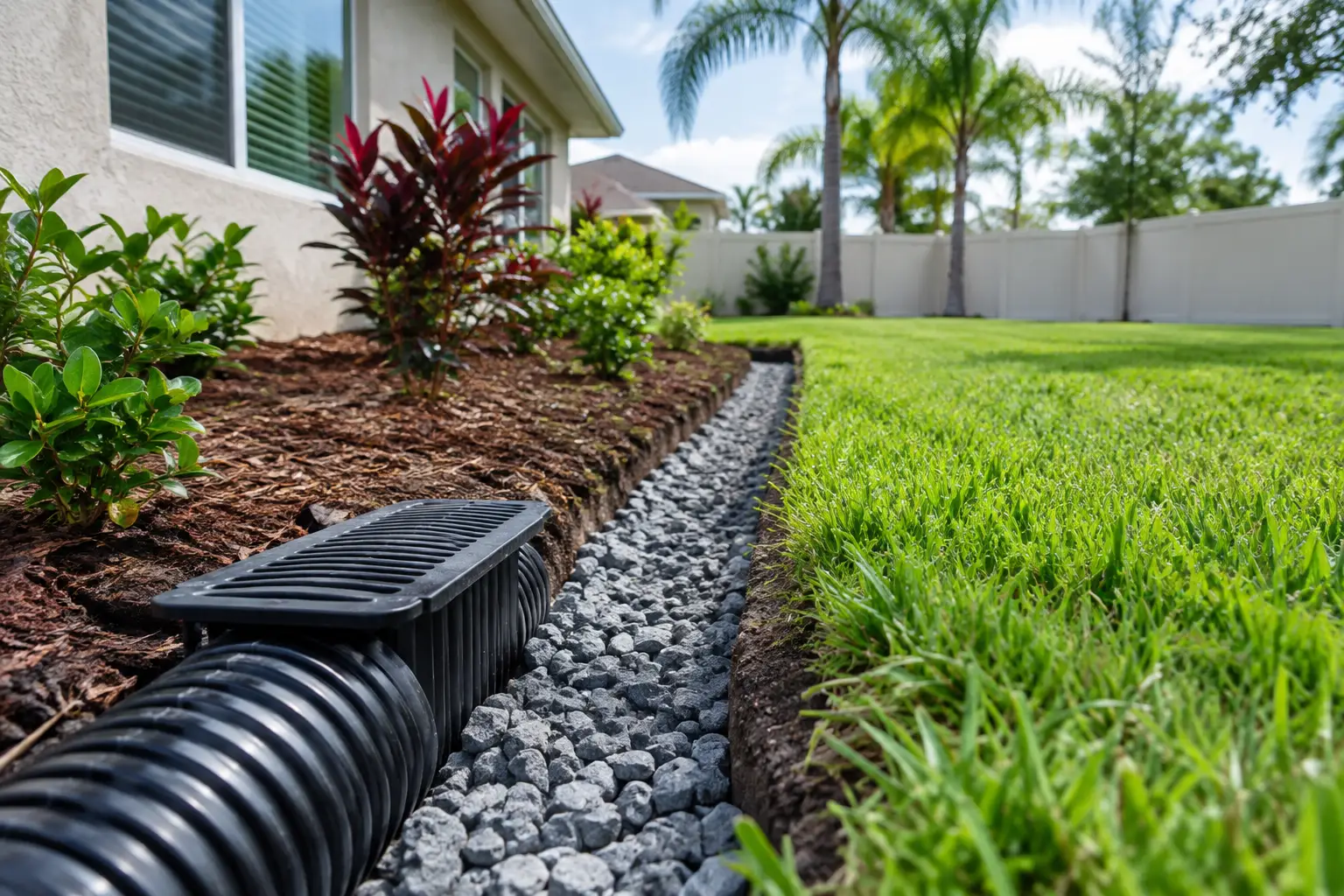
A catch basin is often useful where runoff gathers in one defined area. Water enters through a grate, then travels through buried pipe to a lower area, swale, or other suitable outlet. A channel drain may be a better fit along the edge of a patio, driveway, or pool deck where sheet flow needs to be intercepted before it reaches the house.
French drains can help in certain conditions, particularly where water is moving through the soil rather than pooling only on the surface. They use perforated pipe surrounded by gravel to collect subsurface water. They are not a universal answer, though. In a yard with heavy roof runoff and no practical outlet, a French drain alone may fill up without solving the underlying water problem.
Every drainage system needs a place for water to go. Before installing buried pipe, confirm the outlet is appropriate for your property and local conditions. Sending water directly against a fence, onto a neighboring lot, or into an area that already floods simply moves the issue.
Protect Patios, Pools, and Outdoor Living Areas
Backyard drainage deserves extra attention around hard surfaces. Concrete patios, pavers, pool decks, and outdoor kitchens do not absorb water, so they can direct a large volume toward a single edge. Even a slight slope in the wrong direction can leave water against the home or create slippery walking surfaces.
Watch for water running under pavers, washing joint sand away, or collecting at the base of screen enclosures. These signs may point to a missing drain, settled base material, or an outlet that has become blocked. In some cases, a simple channel drain or a corrected downspout route is enough. In others, the hardscape slope itself may need to be adjusted.
Keep landscape mulch and decorative stone from blocking drainage paths. Mulch can wash into yard drains, cover catch basin grates, and hold moisture against the home when applied too deeply. A clean edge and an open flow path make routine maintenance easier.
Choose Landscaping That Supports Drainage
Landscaping should help move and absorb water, not create a dam. Raised planting beds, edging, retaining borders, and dense ground cover can all interrupt natural runoff when placed without a plan. If a flower bed sits between a downspout and the rest of the yard, make sure water has a clear route through or around it.
For areas that stay damp, select plants that tolerate periodic wet conditions rather than repeatedly replacing grass that cannot handle the site. Improving soil with organic material can also help compacted areas absorb water more evenly, although it will not correct major roof runoff or a poorly graded lot.
A shallow swale can be an effective landscape feature when the property has enough room and a safe direction for water to travel. It is a broad, gently sloped channel that guides water across the yard without looking like a ditch. This approach works best when it is designed around the yard’s natural grade instead of fighting it.
Know When to Call a Professional
Some drainage fixes are straightforward, such as clearing a clogged downspout or adding a properly placed extension. Others require experience with roof runoff, gutter sizing, grading, underground piping, and exterior water management. If gutters overflow during routine storms, downspouts drain too close to the home, or water repeatedly collects near the foundation, professional service can help identify the most direct solution.
For Orlando homeowners, the right gutter work is often the first and most cost-effective step. Precision K-Gutters can inspect gutter flow, repair problem areas, adjust downspouts, and provide custom-fit seamless gutter solutions that help control roof runoff before it reaches the backyard.
A dry, usable backyard usually comes from several small details working together: clear gutters, correctly placed downspouts, soil that slopes away from the home, and drainage paths that stay open. Address the water at its source, and the rest of the yard becomes much easier to protect.