
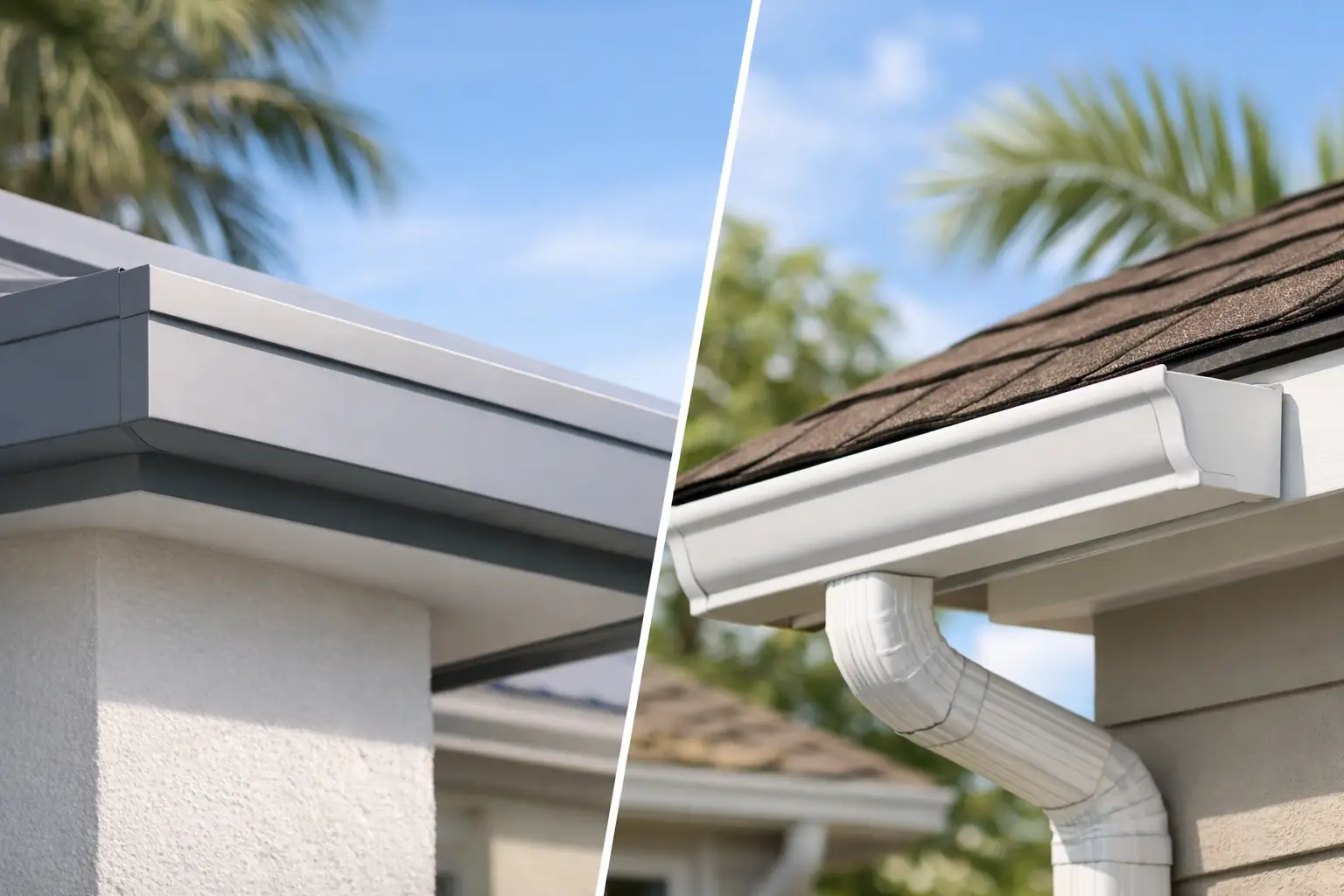
When a Central Florida downpour starts pushing water over the edge of a roof, the gutter profile matters more than most homeowners realize. The choice between box gutters versus k gutters affects how water moves off the roof, where it goes next, how the system looks, and how much maintenance it may need over time.
For many Orlando-area homes, seamless K gutters are the practical choice because they work well with common residential rooflines and fascia boards. Box gutters can be a good fit in specific situations, especially on certain architectural styles or roofs with high water volume. The right answer depends on the home, the roof layout, and the condition of the existing drainage system.
What Is the Difference Between Box Gutters and K Gutters?
The main difference is the shape and installation method. K gutters are the familiar residential gutters seen on many homes. Their front edge has a decorative profile that resembles the letter K when viewed from the side. Box gutters have a rectangular or square-shaped channel and are often larger, more concealed, or built into the roof structure.
K Gutters
K gutters are typically attached along the fascia board at the roof edge. They are available in several sizes, with 5-inch and 6-inch options being common for residential properties. A seamless K-gutter system is formed on-site to match the lengths of each roofline, reducing the number of joints where leaks can develop.
The profile provides good water capacity without looking oversized on most homes. K gutters also work well with standard downspouts and can be installed in aluminum, the material most homeowners choose for its low maintenance and resistance to rust.
Box Gutters
Box gutters have straight sides and a flat bottom, creating a deeper, more angular channel. Some are mounted at the roof edge, while traditional box gutters are integrated into the roofline and hidden behind a parapet or trim. You may see them on older homes, historic properties, flat or low-slope roofs, and some modern architectural designs.
Because their design can vary widely, box gutter repairs and replacement often require closer inspection. A built-in box gutter may involve roofing materials, flashing, trim, and hidden structural components. It is not always a simple matter of removing one section and installing a new one.
Box Gutters Versus K Gutters for Florida Rain
Florida rainfall is not always a slow, steady event. A short storm can send a large volume of water off a roof in minutes. Both gutter styles can manage heavy rainfall when they are properly sized, correctly pitched, and connected to downspouts that can carry water away efficiently.
Box gutters generally have more open capacity because they can be made wider and deeper. That can be useful on a large roof plane, a low-slope roof, or a property where water is concentrated into a limited drainage area. However, extra gutter capacity does not solve every overflow issue. If the downspouts are too small, too few, clogged, or poorly placed, water can still back up and spill over.
K gutters handle water very effectively on most single-family homes when the sizing matches the roof area. A 6-inch K-gutter system with properly sized downspouts is often a strong option for homes that receive intense seasonal rain. The key is to evaluate each roof section instead of assuming one gutter size fits the whole property.
Roof pitch also matters. A steeper roof sheds water faster, which can overwhelm an undersized gutter during a hard storm. Valleys matter too. When two roof sections direct water into one point, that area may need a larger gutter, an added downspout, or a different drainage approach.
Appearance and Curb Appeal
K gutters are popular partly because they create a finished, clean edge along the fascia. The decorative front profile works with many traditional and contemporary home styles, and aluminum K gutters are available in a range of colors. A properly installed system should follow the roofline neatly without sagging, uneven seams, or downspouts placed where they distract from the exterior.
Box gutters offer a different look. Surface-mounted box gutters have a more modern, squared-off appearance. Built-in box gutters can be nearly invisible from the ground, which may be important for a historic home or a design where exterior trim needs to remain uninterrupted.
That hidden appearance comes with a trade-off. When a concealed box gutter leaks, the problem may go unnoticed until there is staining, wood damage, or water intrusion near the roof edge. Visible K gutters make it easier to spot clogs, standing water, loose fasteners, and damage before a minor issue becomes a larger repair.
Installation and Leak Risk
Installation quality matters as much as gutter style. Gutters need a consistent slope toward downspouts, secure attachment to the fascia, properly sealed end caps and outlets, and a discharge path that moves water away from the home.
Seamless K gutters reduce the number of joints along long runs. Fewer seams generally mean fewer places for water to escape over time. There will still be sealed connections at corners, end caps, outlets, and downspouts, so routine inspection is still worthwhile.
Box gutter installation can be straightforward when the system is externally mounted. Built-in systems are more specialized. They may require careful flashing details and coordination with roof repairs. If the liner or waterproofing inside a built-in box gutter fails, water can reach the fascia, roof decking, or wall assembly before it becomes visible outside.
For a standard Orlando home with accessible fascia boards, seamless K gutters are usually the more direct and cost-effective installation. For a property with existing built-in box gutters, preserving the original design may be the better choice, but it should be approached with the right repair plan rather than a quick patch.
Maintenance Needs for Each Style
No gutter style stays maintenance-free in a storm-prone area. Oak leaves, pine needles, roof grit, seed pods, and shingle debris can collect inside any open channel. A clean, properly draining gutter is far less likely to overflow at the first heavy rain.
K gutters are generally easy to access for cleaning and inspection. Homeowners or property managers can often see debris buildup from the ground, especially when water spills over the front edge. Gutter guards may reduce the amount of debris that enters the system, but they still need to be selected and installed with the roof and local debris types in mind.
Box gutters can collect debris in their wider channels, and concealed versions may be harder to inspect. Their drains and outlets need special attention. A small blockage in a hidden box gutter can allow water to pool where it should not, adding weight and increasing the chance of leakage into the structure.
Regardless of profile, watch for overflow, drips at seams, sagging sections, peeling paint near the fascia, water marks under the roof edge, and soil erosion around downspout outlets. These are signs that the system may need cleaning, repair, or drainage adjustments.
When K Gutters Make the Most Sense
K gutters are usually the best fit for homes with conventional sloped roofs, visible fascia boards, and a need for dependable drainage without major exterior changes. Their combination of capacity, appearance, accessibility, and cost makes them a practical choice for most residential properties in Orlando.
They are especially useful when an older sectional system has repeated leaks at the joints. Replacing it with custom-measured seamless K gutters can create a cleaner look and reduce unnecessary seam points. Adding or repositioning downspouts at the same time can improve how water moves away from the foundation, walkways, patios, and landscaped areas.
When Box Gutters May Be the Better Choice
Box gutters may be appropriate when the home already has them, the roof design requires a deeper channel, or the architecture depends on a concealed drainage system. They can also be useful for certain large roof areas where water volume calls for a custom solution.
The decision should not be based on capacity alone. A box gutter that is poorly flashed or difficult to maintain can create more risk than a properly sized K-gutter system. For older or architecturally distinctive homes, an on-site assessment can determine whether repair, relining, reconstruction, or a redesigned external gutter system makes the most sense.
Choose the System Around the Water Path
The best gutter system is not simply the biggest one or the one with the most familiar profile. It is the system that matches the roof, captures water where it falls, stays clear during the rainy season, and sends runoff to a safe location away from the home.
Before replacing gutters, look at the full water path: roof planes, valleys, gutter size, downspout locations, discharge points, and the condition of the fascia behind the existing system. Precision K-Gutters can assess those details on-site and provide a clear recommendation based on what your property actually needs. A few well-planned adjustments now can help keep the next hard rain where it belongs – moving away from your home.