
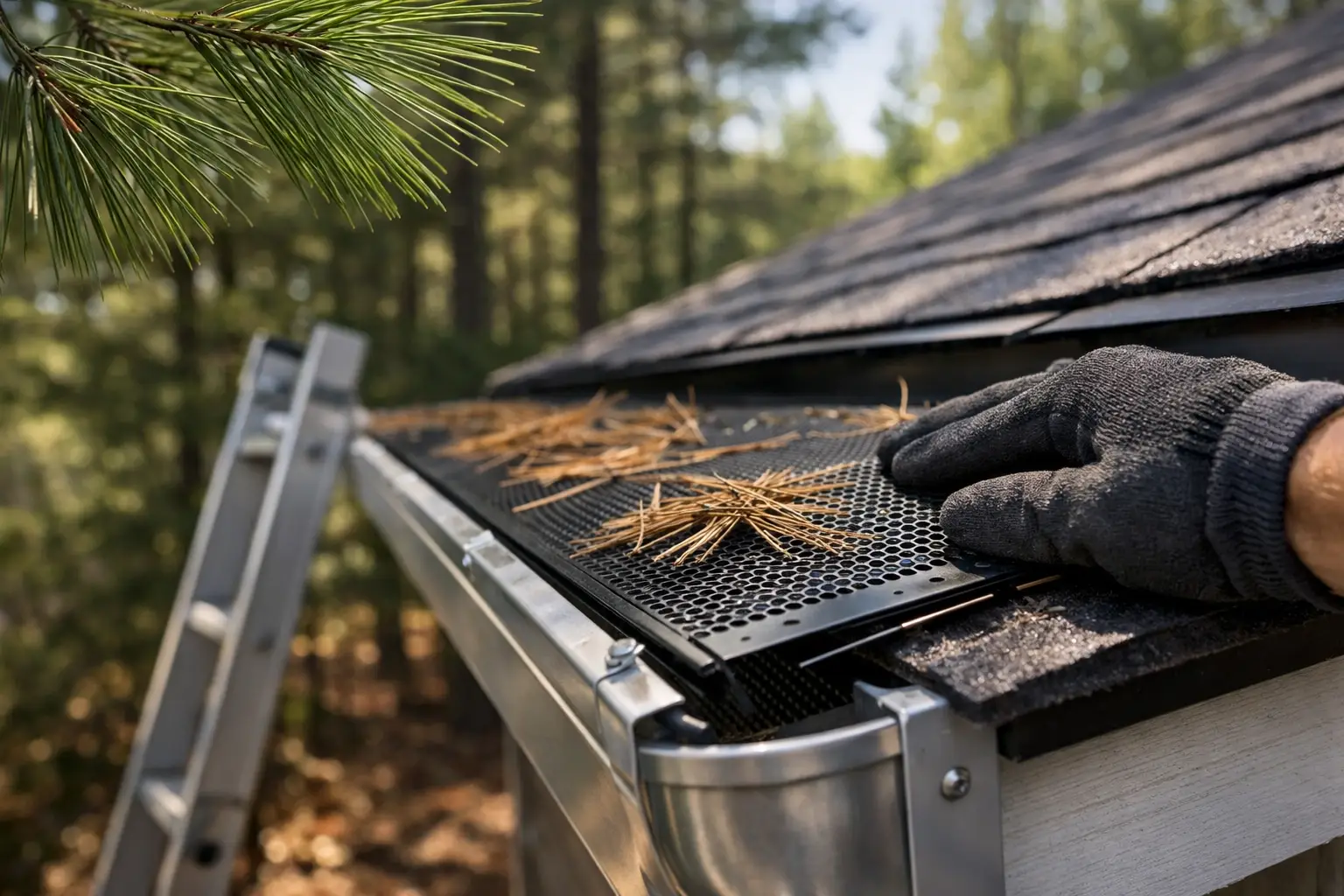
If you have pine trees near the roofline, you already know standard gutter protection can come up short. Leaf guard installation for pine needles is a different job than blocking larger leaves, because pine straw is thin, light, and quick to pack into small openings. Once that buildup starts, water can skim over the gutter, spill at the edge, and leave you dealing with fascia rot, stained siding, and soggy ground around the foundation.
In Central Florida, that problem gets worse fast. A light layer of pine needles may not look like much during dry weather, but one hard rain can turn a minor clog into overflow. That is why the right guard matters, but so does the way it is installed. Homeowners often focus on the product alone and miss the bigger issue – if the gutter pitch is off, the downspouts are undersized, or the guard does not sit correctly, the system will still struggle.
Why leaf guard installation for pine needles needs a different approach
Pine needles do not behave like oak leaves or magnolia leaves. They slip into gaps that stop larger debris, and they can crosshatch together into a mat that traps shingle grit, seed pods, and roof debris. On some guard styles, that mat forms on top of the surface. On others, it works its way through and builds inside the gutter trough.
That is why broad claims like “keeps all debris out” should be treated carefully. No gutter protection system is completely maintenance-free, especially on homes surrounded by pines. The real goal is to reduce how often gutters clog, improve water flow during heavy rain, and make future maintenance easier and less frequent.
For most homes, success comes from matching the guard style to the roofline, tree cover, gutter size, and rainfall conditions. A product that performs well in a neighborhood with light leaf drop may struggle on a property with multiple tall pines and frequent summer storms.
What actually works against pine needles
The best-performing systems for pine-heavy properties usually rely on fine filtration or surface tension designs, but each has trade-offs.
Micro-mesh guards
Micro-mesh guards are often one of the better choices for pine needles because the openings are small enough to block thin debris before it enters the gutter. When installed properly, they can sharply reduce clogs from pine straw while still allowing water into the system.
The key phrase is “installed properly.” If the mesh is set too flat, too steep, or below the roof edge in the wrong way, water can overshoot in hard rain. Lower-quality mesh can also warp, separate, or clog with shingle granules over time. On an older roof that sheds a lot of grit, that matters.
Surface tension or reverse-curve systems
These systems are designed so water wraps into the gutter while debris slides off the edge. They can work well in some conditions, but pine needles are often the test. Because pine straw is so light, it may cling, collect at the nose, or wash into the opening if the design is not right for the roof slope and rainfall volume.
On some homes, these systems perform well enough. On others, they need more touch-up cleaning than expected. They are not automatically a bad choice, but they need to be evaluated based on the property, not just the sales pitch.
Basic screen guards
Large-hole screens are usually the weakest option for pine needles. They may block bigger leaves, but pine straw can pass through or get stuck across the openings. That often leaves homeowners with the worst of both worlds – debris still enters the gutter, and cleaning becomes more awkward because the guard is in the way.
These systems may cost less upfront, but they often do not deliver the long-term value people want on pine-heavy lots.
Installation matters more than most homeowners expect
A good product cannot correct a bad gutter system. Before any leaf guard installation for pine needles, the installer should be looking at the condition of the gutters themselves.
If sections are loose, pulling away, or holding standing water, those issues should be corrected first. Guards are not a fix for poor slope, damaged fasteners, separated seams, or undersized downspouts. In fact, installing guards over problem gutters can hide issues until water damage shows up on trim, soffits, or landscaping.
Fit is another major factor. Seamless K-style gutters with a clean, custom fit often provide a better base for guard installation than older sectional gutters with multiple joints. Fewer seams mean fewer weak points, and that helps the whole system work the way it should during Florida downpours.
The roof edge also matters. Shingle overhang, drip edge detail, fascia condition, and roof pitch all affect how water enters the gutter. A guard needs to be integrated with those details, not forced into place. When installation is rushed, water performance usually shows it.
The most common mistakes with pine needle gutter protection
A lot of gutter guard problems start with expectations that were never realistic. If a home sits under heavy pine coverage, some maintenance will still be needed. The right setup reduces cleaning. It does not erase it forever.
Another common mistake is choosing based on price alone. Lower-cost products may look similar from the ground, but pine needles expose weak designs quickly. A cheap screen that clogs every season or lets debris into the trough is not saving money if you are still paying for repeated service calls.
There is also the issue of ignoring drainage capacity. If the gutter size or downspout layout is already marginal, adding a guard may not solve overflow during hard rain. The water volume in Orlando storms can be intense, and a system needs enough capacity to move that water away from the house.
How to tell if your home is a good candidate
Most homes with nearby pines are strong candidates for gutter guards, but not all properties need the same solution. A single-story home with moderate tree cover may do well with one approach, while a two-story property with valleys, long roof runs, and dense pine drop may need a more protective setup and occasional scheduled maintenance.
A good assessment should consider how often the current gutters clog, where overflow happens, whether water pools near the foundation, and whether certain roof sections collect more debris than others. Trouble spots around roof valleys and inside corners usually need extra attention because that is where needles and roof runoff tend to concentrate.
If you are dealing with repeat cleaning, water spilling over entryways, or staining on the exterior walls, it makes sense to have the full gutter system evaluated instead of just adding a guard and hoping for the best.
What Orlando-area homeowners should prioritize
In this market, debris control is only half the job. The other half is handling sudden, heavy rain without overflow. That means homeowners should prioritize a leaf guard system that can block fine debris while still supporting strong water intake.
It also means working with a company that understands local conditions. Pine needles, roof runoff, storm volume, and the way Florida homes are built all affect performance. A clean-looking install is not enough. The system has to keep water moving where it belongs.
That is where straightforward recommendations matter. If a home needs repairs before guards, that should be said clearly. If one guard style is a poor fit for the roofline, that should be explained before installation, not after the first big storm. At Precision K-Gutters, that kind of direct guidance is part of doing the job right.
How to choose the right installer
The best installer is not the one promising zero maintenance forever. It is the one looking closely at the entire drainage system and explaining what will work on your property, what may need adjustment, and what level of upkeep to expect.
Ask whether the gutters will be inspected for pitch, fastening, leaks, and downspout performance before the guard goes on. Ask how the chosen product performs with pine needles specifically, not just leaves in general. And ask what happens at high-flow roof areas, because those sections often reveal whether the system was planned carefully.
A reliable installation should leave you with cleaner lines, better water control, and less frequent clogging, not a new set of problems hidden under a cover.
If pine needles are turning your gutters into a constant maintenance issue, the right answer is usually not more cleaning. It is a better system, installed with attention to how your home actually sheds water.