
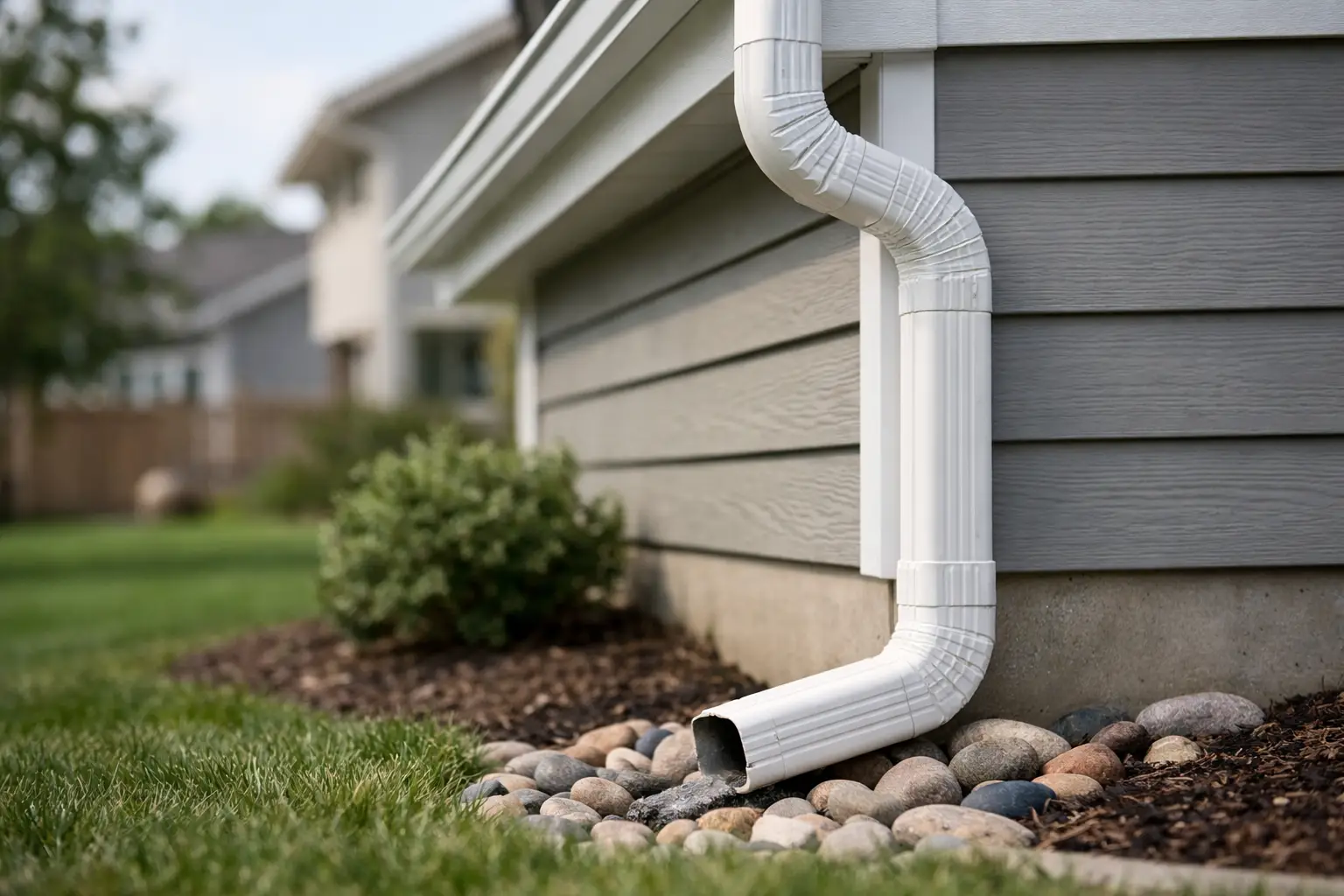
A gutter system can look fine from the street and still cause real drainage problems if the downspouts are in the wrong place. That is why downspout placement rules matter. In Orlando, where a heavy afternoon storm can dump a lot of water in a short time, proper placement is not a small detail. It is what helps move water off the roof, through the gutter system, and safely away from the house.
Most homeowners notice gutters when they overflow. What they do not always see is that the overflow often starts with poor planning at the downspouts. A system may have enough gutter installed, but if the water has to travel too far, collects in the wrong section, or exits too close to the foundation, the whole setup works harder than it should.
What downspout placement rules are trying to solve
The basic goal is simple. Water should leave the roof quickly, flow through the gutter with as little resistance as possible, and discharge far enough from the home that it does not collect near the slab, landscaping, or entry areas.
That means placement is not only about where a downspout fits visually. It is also about roof size, gutter pitch, corner transitions, walkway locations, and the grading around the property. On one house, a front corner may be the cleanest place for a downspout. On another, that same location could dump water right onto a driveway that slopes back toward the garage.
A good layout balances appearance and performance. Homeowners usually want downspouts to blend in, but function has to come first. If a cleaner look leads to poor drainage, the savings in appearance are usually lost in maintenance, staining, and water damage.
Basic downspout placement rules for residential homes
A common rule is that downspouts should be spaced so the gutter can handle the roof area feeding into it. Larger roof sections collect more water, so they often need more than one outlet. Long runs of gutter without enough downspouts tend to back up during hard rain, especially when leaves or shingle grit slow the flow.
Another standard rule is to place downspouts near the ends of gutter runs when possible, since that gives water a direct path out. On longer sections, a center outlet can also make sense if the gutter is pitched toward it from both directions. The right answer depends on the roofline. There is no one layout that fits every home.
Corners are another factor. Water moving through multiple turns has more chance to slow down or collect debris. If a design forces water to travel around several corners before it reaches a downspout, that usually is not ideal. Shorter, more direct drainage paths tend to perform better.
Discharge location matters just as much as the drop itself. Downspouts should not release water right at the base of the house. They should direct runoff away from the foundation, away from low spots, and away from places where water can wash out mulch, erode soil, or create slippery surfaces.
How many downspouts does a house need?
This is where simple rules meet real-world conditions. As a general idea, more roof area requires more drainage capacity. A small section over a porch may only need one downspout. A long rear gutter catching a large roof plane may need two or more.
The length of the gutter run matters too. Even if the roof area is moderate, a very long stretch with only one downspout can struggle in a Florida storm. Water has farther to travel, debris has more room to build up, and overflow becomes more likely at the far end.
Gutter size also affects the answer. A larger seamless K-gutter system can carry more water than a smaller system, but capacity is never just about the gutter profile. The downspouts still need to be placed where they can move water efficiently. A bigger gutter does not fix a bad layout by itself.
If a house has frequent overflow in only one area, that does not always mean the whole system is undersized. Sometimes it means that one section needs an additional downspout or a better discharge path.
Where downspouts should discharge
One of the most overlooked downspout placement rules is that the exit point has to protect the property, not just drain the gutter. Water should be carried away from the home in a way that matches the grade of the lot.
For many homes, that means using extensions, splash blocks, or tied-in drainage depending on the layout. The key is to avoid dumping water where it can cycle back toward the house. If runoff is pooling near the slab, staining siding, or carving channels through the flower beds, the discharge point is not doing its job.
This is especially important around entryways, pool decks, patios, and AC pads. A downspout may technically move water away from the roofline while still creating a nuisance or hazard at ground level. Good placement looks at the full path of the water, not just the vertical drop.
Common placement mistakes homeowners run into
One common issue is putting too much faith in symmetry. Even spacing can look nice, but roofs are not always balanced in the way they shed water. One side may collect much more runoff due to slope, valleys, or adjoining sections. A layout that looks centered may still drain unevenly.
Another mistake is placing a downspout where it is easiest to install, not where it drains best. That can lead to water dumping onto a walkway, between closely spaced homes, or into an area that stays wet after every storm.
Undersizing the number of outlets is another frequent problem. This often happens after additions, screen enclosures, or roofline changes, where the original gutter layout no longer matches the water load.
There is also the issue of hidden clogs and poor maintenance. Sometimes the placement is acceptable, but elbows at the bottom or upper offsets collect debris and reduce flow. In those cases, the downspout location may still need adjustment if the original route creates too many choke points.
Why Orlando homes need a practical approach
Central Florida weather changes the conversation. A system that handles light rain in another region may struggle here during sudden, high-volume storms. Downspout placement rules are more than a code or design question in this market. They are part of protecting foundations, fascia, soffits, siding, and landscaping from repeat water exposure.
Homes in Orlando also deal with flat or subtle lot grading, dense landscaping, screened patios, and tight side-yard conditions. Those details limit where water can be discharged safely. A downspout cannot just end wherever the gutter run does. It has to work with the actual drainage conditions around the home.
That is why local experience matters. A layout that seems acceptable on paper may still create problems after the first few hard storms if the installer did not account for runoff patterns on the property.
When adjustment makes more sense than replacement
Not every drainage problem means the whole gutter system needs to be redone. In many cases, the fix is more targeted. A downspout can be relocated, an extra outlet can be added, or the discharge point can be extended to a better area.
That said, there are trade-offs. Adding more downspouts can improve drainage but change the look of the home. Relocating one may solve pooling in one spot while requiring a more visible drop on another elevation. The best option is usually the one that protects the house first and keeps the appearance as clean as possible second.
For homeowners who want fewer leak points and a cleaner finish, seamless K-gutter systems give more flexibility in creating a layout that fits the roofline correctly. Precision K-Gutters often sees cases where the issue is not the entire system, but a few placement decisions that are causing repeated trouble.
Signs your downspout placement may be wrong
You do not need to wait for major damage to spot a problem. If one area of gutter regularly overflows, if water ponds near the house after rain, or if mulch keeps washing out below a discharge point, the layout may need attention.
Other signs include staining on siding, erosion at corners, damp soil that never seems to dry, or water crossing walkways where it should not. Even mosquito activity can increase when runoff collects in low spots around the home.
A quick visual check during a storm tells you a lot. Watch where the water enters the gutter, how fast it moves, and where it exits. If it spills over before reaching the downspout or rushes out into an area that cannot handle it, the system is telling you something.
Good downspout placement is not about following one rigid formula. It is about matching the gutter system to the roof, the lot, and the way water actually moves around the property. When the layout is right, you notice fewer problems, less cleanup, and better protection where it counts most. If your gutters are doing their job but the water still ends up in the wrong place, that is usually the point where a professional adjustment is worth making.