
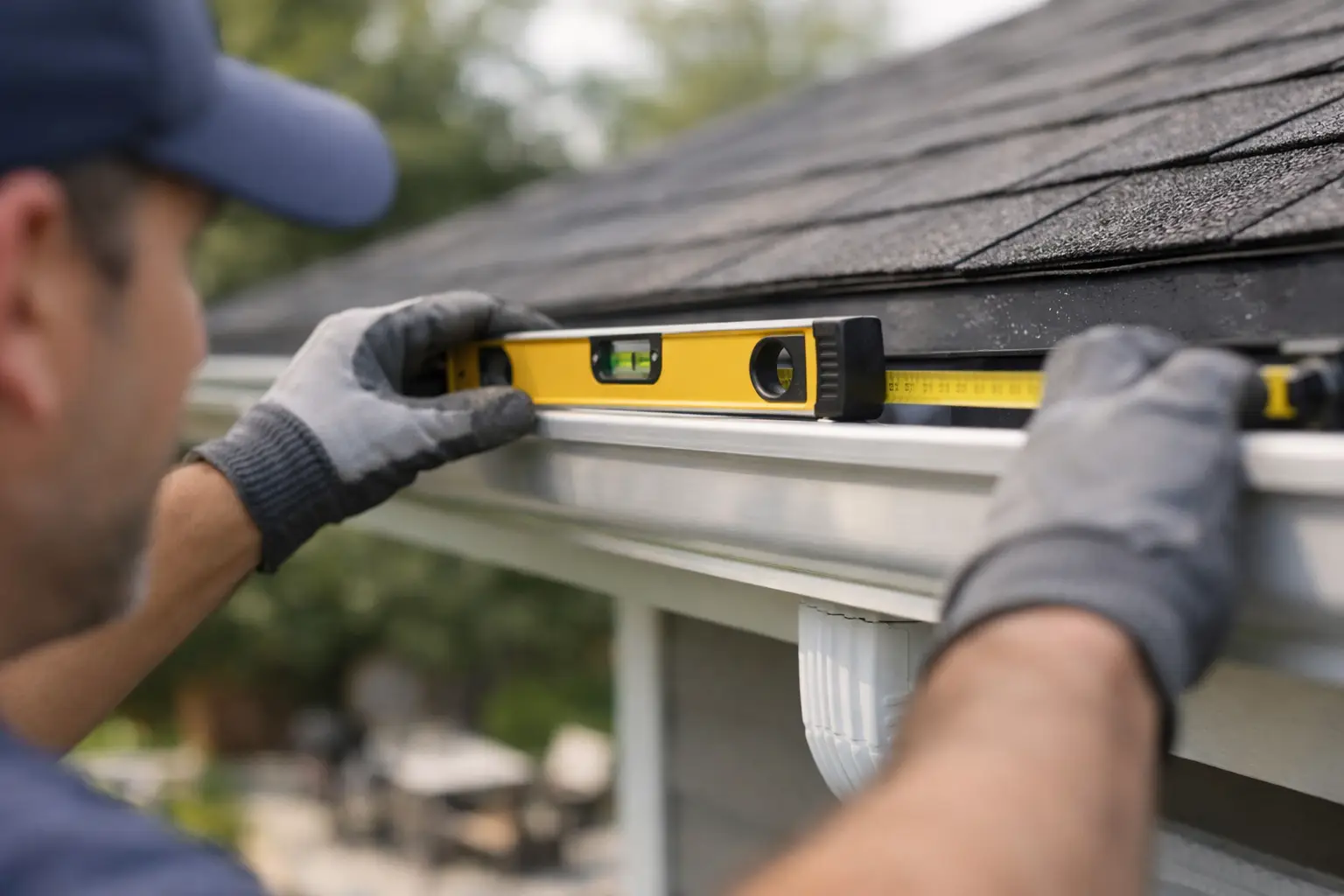
If water sits in your gutters long after a Florida rainstorm, the problem may not be a clog alone. A gutter can look fine from the ground and still be pitched the wrong way. Knowing how to check gutter slope helps you catch drainage problems early, before they turn into overflow, fascia damage, wood rot, or water pooling near the foundation.
Gutters are supposed to move water steadily toward the downspouts. That only happens when the run has a slight, consistent pitch. Too flat, and water stands in the trough. Too steep, and water can rush too quickly, overshoot problem areas, or leave parts of the system draining unevenly. In Central Florida, where heavy downpours can test every part of an exterior drainage system, even a small slope issue can show up fast.
Why gutter slope matters more than most homeowners think
A gutter system does not need a dramatic angle to work well. In fact, the proper pitch is usually subtle enough that you may not notice it by eye. But subtle does not mean optional. Without the right slope, rainwater can collect in sections of the gutter, add weight, pull fasteners loose, and increase the chance of leaks at seams, corners, and end caps.
Poor slope also tends to create misleading symptoms. Homeowners often assume the issue is debris, a bad downspout, or a damaged section of gutter. Sometimes that is true. Just as often, the real problem is that the water has no clear path to the outlet.
How to check gutter slope step by step
You do not need specialized equipment to do a basic check. A sturdy ladder, a tape measure, a level, and a careful approach are usually enough. If your home has a second story or the ground is uneven, it is safer to leave the inspection to a professional.
Start by locating the downspout. Every gutter run should slope toward a downspout or toward a central outlet, depending on how the system was designed. Once you identify the intended drainage direction, you can check whether the gutter actually drops as it moves toward that point.
Set your ladder on stable ground and inspect one gutter section at a time. Place a level along the front edge or inside bottom of the gutter, depending on what you can reach safely. If the gutter is properly pitched, you should see a slight drop toward the downspout rather than a perfectly level line.
A common rule of thumb is about one-quarter inch of slope for every 10 feet of gutter. That means a 20-foot run usually needs about one-half inch of total drop. Some systems may vary slightly based on layout and drainage demands, but that range works for most residential homes.
Measuring the drop
For a more accurate reading, measure from a fixed point near the high end of the gutter to the bottom of the gutter trough. Then measure again near the downspout end. The difference between those two measurements tells you how much drop the run has.
For example, if the high end measures 3 inches from your reference point and the downspout end measures 3 and one-half inches, that section has dropped one-half inch. If that run is about 20 feet long, the slope is likely within a workable range. If there is almost no difference, or if the high and low points are reversed, the gutter needs adjustment.
Use a water test if needed
Sometimes a visual check and level check still leave room for doubt. In that case, run water through the gutter with a garden hose. Start at the end opposite the downspout and watch how the water moves. It should flow steadily toward the outlet without lingering in the middle.
If water stalls, forms puddles, or backs up in one section, that usually points to one of three problems: improper slope, a partial blockage, or a sagging section of gutter. The hose test is especially useful because it shows how the system behaves under flow rather than just how it looks when dry.
Signs the gutter slope is off
Many homeowners do not check gutter pitch until they see evidence of a larger issue. That is common, especially when the gutter is technically attached but no longer draining correctly.
The clearest sign is standing water in the gutter after rain has stopped. You may also notice overflow during storms, especially near the middle of a run instead of at the downspout. In other cases, the gutter may pull away from the fascia, develop drips at seams, or leave dark water marks on the exterior wall below.
If one area repeatedly fills with debris, that can also point to poor slope. Wet leaves and shingle grit settle where water slows down. Over time, that low spot becomes more prone to clogs, added weight, and further sagging.
When the issue is slope and when it is something else
This is where it depends. A gutter with the correct slope can still overflow if the downspout is clogged, the outlet is undersized, or the gutter itself is too small for the roof area. On the other hand, a gutter with a light debris load may still drain badly if the pitch is wrong.
That is why it helps to look at the full condition of the system. Check for loose hangers, bent sections, joint separation, and downspouts that discharge too close to the house. If the metal is warped or the fasteners have started pulling out, fixing the slope alone may not hold for long.
Older sectional gutters deserve a closer look because seams and brackets can shift over time. Seamless systems generally have fewer leak points, but they still need proper support and alignment to drain as intended.
How to check gutter slope safely
Any ladder work comes with risk, and gutter checks often happen after rain, when surfaces are slick. If you are going to inspect your gutters yourself, wait for dry conditions, use a stable ladder, and avoid overreaching. Move the ladder often instead of stretching to inspect one more section.
For single-story homes, a basic inspection may be manageable for many homeowners. For taller homes, steep rooflines, or areas around landscaping and pool decks, safety becomes the bigger issue. In those situations, it makes more sense to schedule a professional inspection than to force a DIY measurement from an awkward ladder position.
What happens if the slope is wrong
Minor slope issues can sometimes be corrected by adjusting hangers or re-securing part of the run. That said, the best fix depends on why the pitch changed in the first place. If the gutter was installed incorrectly, it may need to be reset. If the fascia board is soft or rotted, the gutter may not hold its alignment until that wood is repaired.
A section that has started sagging from retained water or debris weight may also need more than a simple tweak. Brackets may need replacement, the outlet may need clearing, or the run may need to be rehung for a more consistent fall. If the gutter has multiple low spots, patchwork adjustments can turn into repeated service calls.
That is one reason homeowners in Orlando often benefit from a direct inspection instead of guessing at one visible problem. Heavy rain tends to expose every weak point in the system at once.
How often should you check gutter slope?
A basic visual check once or twice a year is usually enough for most homes, especially before and during the rainy season. It also makes sense to inspect after a major storm, after tree limbs have hit the gutter line, or any time you see new overflow.
If you already know your gutters have had past repair work, settling, or recurring drainage issues, check them more often. Property managers should pay close attention between tenants as well, since small drainage problems can become expensive exterior repairs when left alone.
When to call a professional
If your gutters hold water, overflow in the same spot, or appear twisted or loose, it is time for a closer evaluation. A professional can tell whether the problem is pitch, blockage, fastening, outlet capacity, or a combination of issues. That matters because the wrong fix wastes time and does not protect the home.
Precision K-Gutters handles these kinds of drainage problems with a practical approach – inspect the system, identify where water is failing to move, and recommend the repair that makes sense for the condition of the gutter.
If you are trying to figure out how to check gutter slope, the goal is not just getting a measurement. It is making sure rainwater leaves the roofline the way it should, before it has a chance to damage the parts of your home you cannot easily replace.