
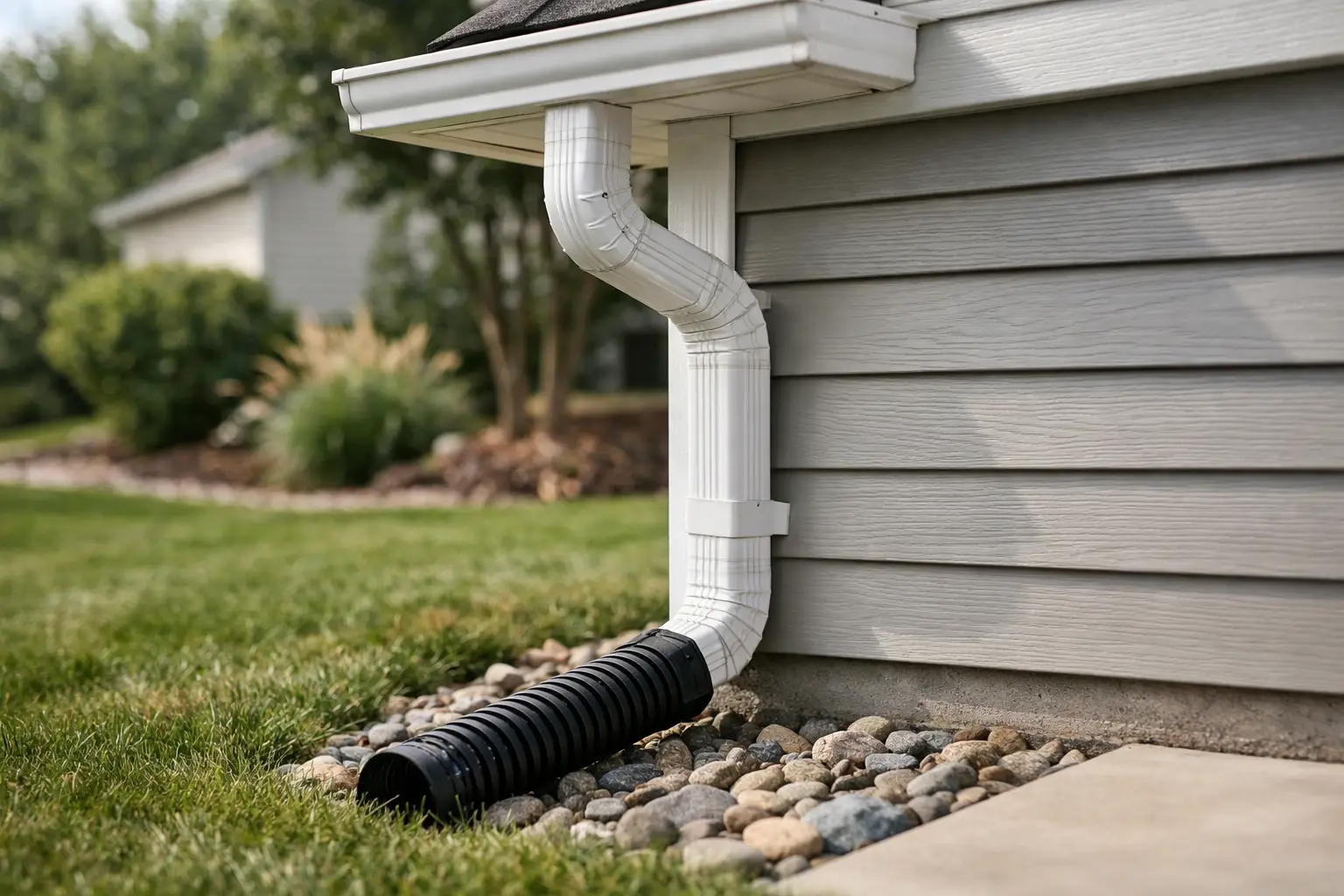
A gutter system can look fine from the street and still send hundreds of gallons of rainwater to the worst possible spot. That is why a solid guide to downspout placement around homes matters. If downspouts are placed without considering roof layout, soil slope, walkways, and foundation lines, you can end up with pooling water, washed-out mulch, stained siding, and damage that builds slowly over time.
For homeowners in Central Florida, this is not a small detail. Heavy rain can test every part of your drainage system fast. Good downspout placement helps water leave the roof, move away from the house, and stay out of areas where it can create problems.
Why downspout placement matters more than most homeowners think
Gutters collect water, but downspouts do the real work of getting that water off the structure and away from the home. If they are undersized, too few in number, or placed at poor discharge points, the whole system underperforms.
The most common issues are practical ones. Water may dump too close to the slab, wash out planting beds, flood a low corner of the yard, or create slippery areas near entry points. In some cases, poor placement also leads to recurring gutter overflow because the water cannot move through the system efficiently during a strong storm.
A properly placed downspout should do two things well. It should accept water from the gutter without backing up, and it should discharge water where it can drain safely away from the house. Both parts matter.
Guide to downspout placement around homes: what to look at first
The right layout starts with the roofline. Long gutter runs usually need more than one downspout, especially where a large roof area is draining into a single section. A short run over a small porch may only need one. A long rear elevation with multiple valleys feeding into it may need several.
The next thing to evaluate is slope. Gutters need a slight pitch so water naturally moves toward the downspout. If a downspout is placed at the wrong end of a long run, water can sit in the gutter, collect debris more easily, and overflow during heavy rain.
Ground conditions matter just as much. Even a well-placed downspout at the gutter level can still cause trouble if it empties onto flat ground, compacted soil, or a spot that already stays wet. The goal is not just to move water off the roof. The goal is to move it away from the home in a controlled way.
Where downspouts usually work best
In many homes, corners are the most efficient place for downspouts. They often give installers a clean vertical path, and they can keep the look of the front elevation neat. Corner placement also tends to work well with gutter pitch because water can be directed naturally to either end of a run.
That said, corners are not automatically the best choice. If one corner sits near an AC pad, a walkway, a driveway edge, or a low foundation area, the cleanest-looking location may not be the safest drainage location. Sometimes moving a downspout several feet can improve water control significantly.
On larger roof sections, placing downspouts at both ends of a gutter run is often the better option. This reduces the volume each downspout has to handle and helps the system keep up during Florida downpours. On some homes, a center downspout can also work, but it depends on the design of the fascia, entry features, and where water can safely discharge at grade.
Common placement mistakes that create drainage problems
One frequent problem is putting all focus on appearance and not enough on drainage. Most homeowners want a clean look, and that makes sense. But hiding a downspout behind a landscaping bed does not help if that bed sits against the foundation and collects runoff.
Another mistake is discharging water too close to the house. Even if the gutter itself performs correctly, water that lands right at the base of the wall can lead to settlement concerns, damp soil, erosion, and splash-back on siding or masonry.
Too few downspouts is another issue. A single downspout on a long, high-volume gutter run may seem adequate during light rain, then fail when a summer storm rolls through. If overflow happens repeatedly, the answer is not always cleaning alone. Sometimes the layout itself needs adjustment.
Poor extension planning also causes problems. A downspout can be placed correctly on the wall and still be incomplete if the bottom discharge has nowhere to go. Extensions, splash blocks, and underground drain tie-ins all have a role depending on the lot and runoff pattern.
How far should water discharge from the house?
A good rule is simple: farther is usually better, as long as the discharge point is stable and drains properly. Water should not be allowed to collect right next to the foundation. In many cases, extending discharge at least several feet away helps reduce risk.
The exact distance depends on your yard. If the grade slopes away well and the soil drains properly, a shorter extension may work. If the lot is flat, the soil holds water, or the home has a history of pooling, you may need a longer extension or a more managed drainage solution.
This is where one-size-fits-all advice falls short. Two homes on the same street can need different downspout setups because grading, hardscape, and roof design are rarely identical.
Downspout placement around walkways, driveways, and patios
This is one of the most overlooked parts of downspout planning. Water should not discharge where people walk every day if it can be avoided. A downspout that empties onto a front walk can create staining, algae growth, and slippery conditions.
Driveways have similar issues. Repeated discharge can wash debris across the surface, wear out edge landscaping, and send water back toward the garage if the slope is unfavorable. Patios are another trouble spot, especially if runoff creates standing water near doors or screened enclosures.
When these areas are close to the ideal wall location, the solution is usually not to remove the downspout altogether. It is to route the discharge better with an extension or a drain connection so water ends up in a safer part of the yard.
Special considerations for Orlando-area homes
In Central Florida, downspout placement has to account for intense rain, quick storm buildup, and lots that do not always drain evenly. A system that seems acceptable in a mild climate can struggle here simply because rainfall volume arrives faster.
That is why larger roof sections often benefit from added capacity, not just basic placement. It is also why discharge points should be checked during or after heavy rain when possible. A spot that looks dry most of the week can become a problem area in a single afternoon storm.
Tree coverage also changes the equation. If one side of the home collects more leaves and debris, that side may need more attention to keep water flowing freely into the downspout. Placement and maintenance work together. Even the best layout can underperform if the system stays clogged.
When to adjust an existing downspout instead of replacing the whole system
Not every drainage problem means you need all new gutters. Sometimes the fix is as straightforward as adding a downspout, relocating one, changing the pitch of a gutter run, or improving the discharge extension.
This is especially true when the gutters themselves are still structurally sound. If the recurring issue is overflow at one section, soil erosion below one corner, or water dumping near an entry, targeted adjustments can make a noticeable difference.
That said, there are cases where patching around a bad system is not the best investment. If the gutters are undersized, leaking at multiple joints, pulling away from the fascia, or installed with poor slope overall, replacement may be the cleaner long-term answer.
Signs your current placement may be wrong
You do not need a major failure to know something is off. Warning signs usually show up early. Look for splash marks on siding, trenches in mulch beds, standing water near corners, mildew near the base of walls, and gutters that overflow only in certain sections.
You may also notice extensions that have been kicked loose repeatedly or downspouts that empty into spots you are constantly trying to regrade. Those are signs the water path was never really solved.
For homeowners and property managers, the best approach is direct and practical. Watch what happens during a real rain event. Where does the water go? Does it leave the house efficiently, or does it just relocate the problem a few feet away?
A well-planned downspout layout should feel almost invisible because it works without drawing attention. Water comes off the roof, moves through the system, and exits where it will not damage the home or create a maintenance headache. That is the standard worth aiming for, whether you are correcting one problem corner or planning a full gutter upgrade with a local specialist like Precision K-Gutters.