
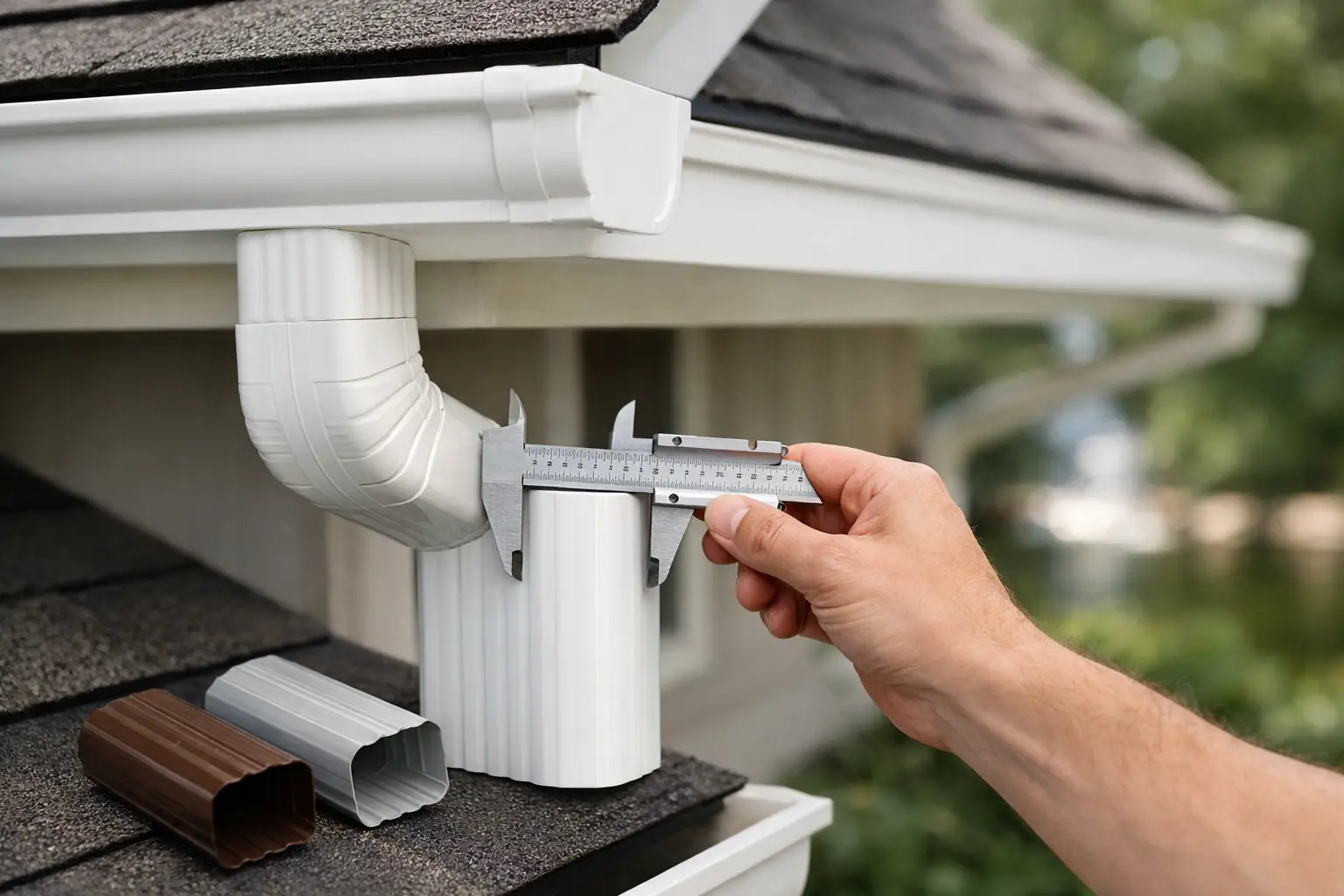
A gutter can be clean, properly pitched, and in good condition yet still overflow during a Central Florida downpour. The problem is often capacity at the exit point. Knowing how to size downspouts correctly means matching the gutter system to your roof’s water load, not simply using the same downspout size and spacing found on a neighboring home.
For Orlando homeowners and property managers, this matters because rain can arrive fast and hard. A system that handles a light afternoon shower may be overwhelmed when a tropical system or summer storm drops heavy rain in a short window. Correct downspout sizing helps water leave the gutter before it spills over fascia boards, stains exterior walls, or collects near the foundation.
Start With the Roof Area That Drains to Each Gutter Run
Downspouts are sized according to the roof area feeding them. This is sometimes called the drainage area. It is not always the same as the home’s total square footage, because each roof plane and gutter run may drain independently.
Start by identifying where the roof sheds water. A simple gable roof may send water to two long gutter runs. A hip roof, intersecting roofline, valley, porch roof, or second-story section can concentrate water into a smaller area. Valleys deserve special attention because they send a large volume of water to one point, often faster than a standard gutter section can move it away.
For a basic estimate, measure the length and width of the roof section that drains into a gutter run and multiply them. A 40-foot-by-20-foot roof section has roughly 800 square feet of drainage area. Sloped roofs, roof pitch, valleys, and complex layouts can increase the effective amount of water reaching the gutter. This is why a professional on-site measurement is more reliable than choosing downspouts based only on the footprint of the house.
Account for Florida’s Heavy Rainfall Rate
Roof area tells you how much surface is collecting rain. Rainfall intensity tells you how quickly that water reaches the gutter. Both factors matter.
A moderate rain may not expose an undersized system. Heavy Orlando storms will. During an intense downpour, every square foot of roof becomes a collection surface, and water can reach the gutter faster than a narrow outlet can drain. If the downspout cannot keep up, water backs up in the gutter and spills over the front edge or behind the gutter.
This is also why a downspout that appears adequate for most of the year can still create damage during the weather events that matter most. Sizing should account for peak conditions, not just average rainfall. Homes with large roof planes, steep pitches, metal roofing, long gutter runs, or valleys generally need extra capacity.
Match Downspout Size to Gutter Size and Layout
Most residential systems use either 5-inch or 6-inch K-style gutters. The downspouts connected to them are commonly 2-by-3-inch or 3-by-4-inch rectangular profiles. A larger downspout has significantly more carrying capacity than a smaller one, so moving up one size can make a meaningful difference during heavy rain.
A 2-by-3-inch downspout may work well on a smaller, straightforward roof section with modest water flow. A 3-by-4-inch downspout is often the better choice for larger drainage areas, long gutter runs, valley locations, and homes where heavy rainfall is common. The larger outlet is also less likely to clog with leaves, roof grit, and small debris.
The gutter itself must be able to deliver water to the downspout. Installing a larger downspout on an undersized or poorly pitched gutter will not solve every overflow problem. Likewise, a 6-inch seamless K-gutter offers more water-carrying capacity than a 5-inch gutter, but it still needs enough properly placed downspouts to empty efficiently.
Determine the Right Number of Downspouts
Sizing is not only about the dimensions of one downspout. It is also about how many exits a gutter run needs and where they are located.
As a practical rule, longer gutter runs and larger roof sections usually need additional downspouts. One outlet placed at the far end of a long run may force water to travel too far, especially when the run receives water from a roof valley. Adding a second downspout shortens the distance water must travel and reduces the chance of backup.
Placement matters as much as quantity. A downspout should generally be located where the gutter can be pitched toward it without creating drainage problems elsewhere. On a long run, installers may pitch from the center toward downspouts at both ends, or use another layout that fits the roofline and discharge plan. The goal is simple: keep water moving without allowing it to pool in the gutter.
More downspouts are not always better if they dump water into walkways, landscaping beds, or areas near the home. Each outlet needs a safe discharge route.
Watch for Signs Your Downspouts Are Too Small
Overflow does not automatically mean the downspout is undersized. Clogs, poor gutter slope, standing water, sagging sections, and leaking seams can create similar symptoms. Still, a few patterns often point to a capacity issue.
If gutters overflow only during the heaviest rain, especially near a valley or at the end of a long gutter run, the system may need a larger outlet or an additional downspout. Water spilling over even when gutters are clean is another warning sign. So is water backing up near the downspout opening while the lower portion of the gutter remains relatively empty.
Look at the ground after a storm as well. Erosion, mulch washout, standing water, and soil pulled away from the foundation indicate that the discharge system needs attention. A correctly sized downspout should move water out of the gutter, but extensions, splash blocks, or buried drainage may still be needed to move it away from the house.
Do Not Forget the Downspout Outlet and Elbows
The narrowest part of the drainage path can limit the entire system. A large downspout connected to a small outlet hole in the gutter will not perform at full capacity. Tight elbows, crushed sections, and poorly aligned connections can also slow water and catch debris.
This is especially relevant when replacing only part of an existing system. If a home is upgraded from 2-by-3-inch downspouts to 3-by-4-inch downspouts, the outlet, elbows, straps, and discharge components should be sized to match. A clean, direct path helps water flow as intended.
Leaf guards can reduce the debris that enters a gutter, but they do not correct undersized drainage. They should be selected and installed as part of a complete water-management plan, with attention to gutter capacity, roof runoff, and maintenance access.
Common Sizing Mistakes to Avoid
The most common mistake is copying a standard layout without considering the roof. Two homes with similar square footage may have very different drainage needs because of roof shape, valleys, pitch, and gutter length.
Another mistake is treating a downspout as an afterthought. A seamless gutter installation looks clean, but appearance alone does not protect the property. The system must have enough outlet capacity to handle the water it collects.
Homeowners also sometimes add an extension to address gutter overflow. Extensions are useful for directing discharged water away from the foundation, but they cannot fix a clogged, undersized, or poorly positioned downspout. Solve the capacity issue first, then make sure the water has somewhere safe to go.
When a Professional Measurement Makes Sense
A quick estimate can help identify an obvious issue, but complex rooflines benefit from a professional assessment. This is particularly true for homes with multiple roof elevations, enclosed patios, valleys, oversized eaves, or recurring overflow during heavy rain.
A gutter professional can measure the roof drainage areas, inspect gutter pitch, identify bottlenecks, and recommend whether the best fix is a larger downspout, an additional outlet, a 6-inch gutter upgrade, cleaning, repair, or a combination of these solutions. Precision K-Gutters custom measures seamless K-gutter systems on-site so the layout fits the home rather than relying on a one-size-fits-all approach.
If water is spilling over during storms, do not wait for stained soffits, rotted wood, or washed-out landscaping to make the decision for you. A properly sized downspout system is a practical investment in keeping roof runoff moving where it belongs: away from your home.