
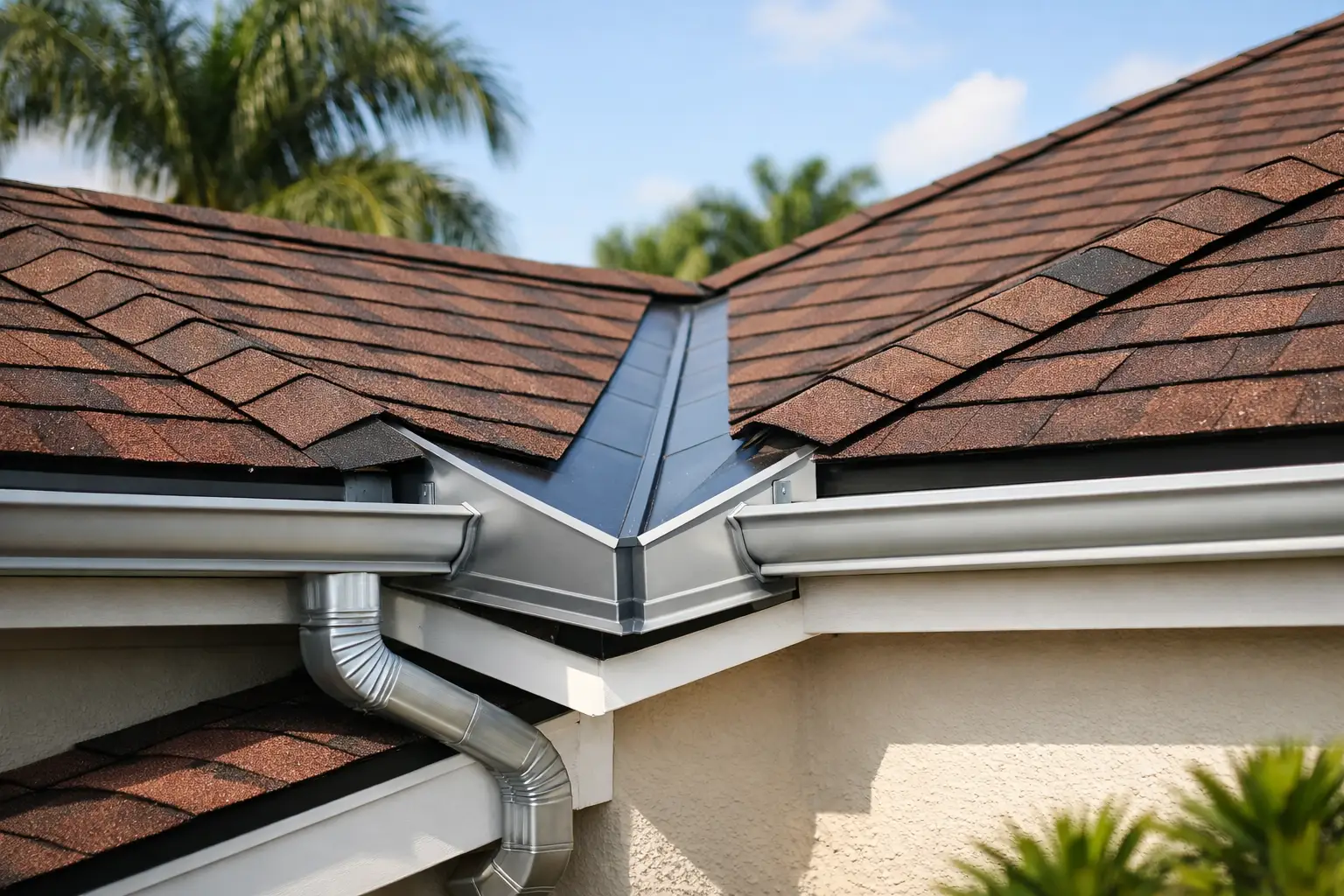
A roof valley can send a surprising amount of water into one short section of gutter. During a Central Florida downpour, water from two roof planes meets at the valley and rushes toward the eave at once. Choosing the best gutters for roof valleys is less about appearance and more about preventing overflow, fascia damage, soaked landscaping, and water collecting near the foundation.
For many Orlando homes, the right answer is a properly sized seamless aluminum K-gutter system with enough downspout capacity to move concentrated water away quickly. The gutter itself matters, but installation details matter just as much. A wide gutter can still overflow if the downspout is undersized, the valley discharge lands in the wrong spot, or debris blocks the outlet.
Why Roof Valleys Need More Gutter Capacity
A roof valley is where two sloped roof sections meet. It acts like a channel, directing rainwater into a concentrated flow. Instead of rain spreading across the entire roof edge, much of it arrives at one point.
That concentration is especially demanding during Florida’s heavy afternoon storms. A gutter system that handles normal rainfall along a straight roofline may struggle where a valley empties. When water overshoots or backs up at that location, homeowners may see staining on the fascia, water behind the gutter, erosion below the roofline, or repeated overflow in the same area.
The goal is not simply to install a larger gutter everywhere. It is to match the gutter width, outlet size, slope, and downspout placement to the roof’s water flow. Homes with steep roof pitches, long valley runs, metal roofing, or multiple valleys often need additional attention.
Best Gutters for Roof Valleys: 6-Inch Seamless K-Gutters
For most homes with active roof valleys, 6-inch seamless K-gutters are the strongest all-around choice. They hold more water than standard 5-inch gutters and provide more room for fast-moving runoff to settle before reaching the downspout.
K-style gutters are a practical fit for residential properties because their shaped front edge blends well with common rooflines while offering good water capacity. When custom formed on-site, seamless sections also reduce the number of joints where leaks can develop over time.
A 5-inch gutter may still work on a small roof with a short valley and modest drainage demands. However, it has less margin during severe rain. In Orlando and surrounding areas, where sudden high-volume storms are common, upgrading to 6-inch gutters is often the better preventive choice when valleys are involved.
When a 7-Inch Gutter May Be Worth Considering
Some properties need more than a standard 6-inch system. A 7-inch gutter may be appropriate for large homes, very steep roofs, long roof runs feeding into one valley, or roof designs where several sections drain toward the same area.
This is not an automatic upgrade for every home. Larger gutters can cost more and may not be necessary if the roof has well-distributed drainage. The right size should be based on the roof layout, valley location, existing overflow patterns, and how the water can be directed into downspouts.
Downspouts Matter as Much as the Gutter
A large gutter cannot perform well if its downspouts cannot keep up. At a roof valley, the downspout should be placed close enough to the concentrated flow to drain the gutter before water builds up and spills over the front edge.
For valley areas, wider 3-by-4-inch downspouts are often a better choice than smaller downspouts. They allow more water and small debris to pass through, which helps reduce bottlenecks during heavy rain. Depending on the roof design, a gutter section may need an additional downspout rather than relying on one outlet at the far end.
Downspout discharge is also part of the solution. Water should be directed away from the home, not dropped beside the foundation or into an area that already stays wet. Downspout extensions and properly planned drainage paths help protect landscaping, walkways, and low areas around the property.
Aluminum Is the Practical Material for Florida Homes
Seamless aluminum is typically the best gutter material for roof valleys in Central Florida. It is lightweight, durable, rust-resistant, and available in colors that match common exterior finishes. It also works well for custom on-site fabrication, allowing the gutter to fit the roofline cleanly.
Steel gutters can be strong, but they require more attention to prevent rust when coatings are damaged. Copper has a distinctive appearance and long service life, but it comes at a much higher cost and is not necessary for most residential drainage needs. Vinyl is generally less reliable in high heat and can become brittle or sag over time.
For homeowners focused on long-term performance and clean appearance, custom-fit aluminum gutters provide a dependable balance of cost, capacity, and maintenance.
Installation Details That Prevent Valley Overflow
The best gutter size can still fail if it is installed without accounting for the valley. Proper installation begins with observing where the water lands and how quickly it moves across the roof edge.
The gutter must be mounted securely to sound fascia and pitched toward the outlet so water does not sit in the channel. At the same time, the gutter should not be pitched so sharply that it looks uneven from the ground. A professional installer balances drainage performance with a clean finished appearance.
At the valley discharge point, the gutter needs to sit in the right position beneath the roof edge. If it is set too low or too far out, fast-moving water can shoot past it. If it is positioned incorrectly under the roofing material, water can run behind the gutter and damage the fascia board.
In certain situations, a valley splash guard can help. This small metal piece is installed near the valley end to keep forceful runoff from jumping over the gutter. It is useful when water consistently overshoots during hard rain, but it is not a substitute for proper gutter sizing and downspout planning.
Do Not Ignore Fascia and Roof Condition
Overflow at a valley can be a gutter problem, but it can also reveal issues with the fascia, drip edge, roof flashing, or roofline. Soft wood behind the gutter, loose fasteners, and deteriorated fascia make it difficult to secure a new system correctly.
Before installing replacement gutters, the mounting area should be inspected. Addressing damaged wood or roof-edge issues first helps ensure the new gutter system has a solid, long-lasting foundation.
Are Leaf Guards Helpful at Roof Valleys?
Leaf guards can help reduce the amount of leaves, pine needles, and roof grit entering a gutter system. For homes with nearby trees, they may reduce cleaning frequency and help keep downspout outlets clear.
However, not every guard performs the same way under concentrated valley flow. Some styles can allow water to overshoot when rain is moving too quickly off a valley. Others may collect debris on top and still require periodic maintenance.
The best approach is to select a guard that works with the roof pitch and gutter profile, then make sure the system is installed with valley runoff in mind. Even with guards, a visual check after major storms is smart. No gutter protection system eliminates maintenance completely.
Signs Your Valley Gutters Need Attention
A gutter issue at a valley usually becomes obvious during or shortly after rain. Watch for water pouring over one spot, dirty streaks on the gutter face, mulch washing away below the roofline, or damp areas near the foundation. You may also notice gutters pulling away from the fascia, standing water in the gutter, or recurring clogs near one downspout.
If the problem occurs only in hard rain, the system may not have enough capacity for the roof’s concentrated flow. If it happens in lighter rain, debris, poor slope, loose sections, or an improperly placed outlet may be involved. A professional evaluation can identify whether a repair, added downspout, splash guard, or full gutter upgrade makes the most sense.
For Orlando homeowners, roof valleys deserve more than a one-size-fits-all gutter solution. A properly measured seamless K-gutter system, sized for the roof and paired with adequate downspouts, gives heavy rain a controlled path away from the home. That is the kind of detail that helps prevent a brief storm from turning into a costly exterior repair.