
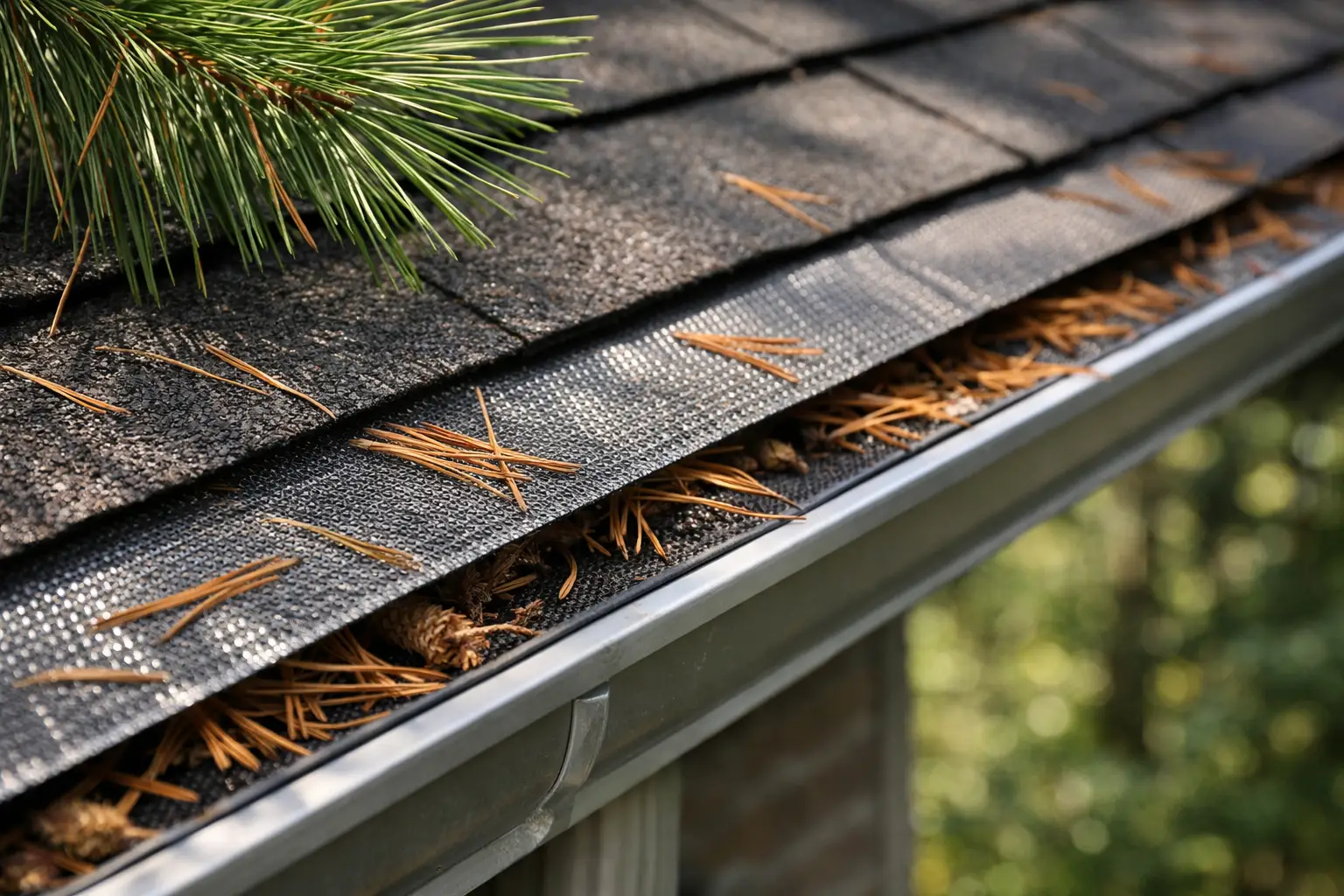
If you have pine trees near the house, you already know regular leaf screens are not always enough. The best gutter guards for pine needles need to do two jobs at once: keep out thin, stringy debris and still let Florida rain move through the system fast enough to prevent overflow.
That combination is where many products fall short. Pine needles are smaller than broad leaves, they tangle easily, and they tend to slide into weak openings or collect on top of guards until water starts to sheet over the edge. In Central Florida, where sudden downpours can hit hard, the wrong guard can create a different problem than the one you started with.
What makes pine needles hard on gutters
Pine needles do not behave like oak leaves or general yard debris. They are narrow, lightweight, and stubborn. Wind can push them into small gaps, and once a few get stuck, they start catching more. That buildup can block water flow, weigh down sections of gutter, and send runoff over the front edge during a storm.
They are also more likely to collect at roof valleys and corners where water moves with extra force. If your home has pine trees overhead, one-story roof lines may still clog quickly, and second-story sections can become harder to monitor until you notice staining, overflow, or erosion below.
The best gutter guards for pine needles usually fall into three categories
For most homes, the best performance comes from micro-mesh guards, well-designed reverse-curve systems, or solid-surface helmet-style covers with a proper nose angle. The right choice depends on your roof pitch, how close the pine trees sit to the house, and how intense your rain events are.
Micro-mesh gutter guards
Micro-mesh guards are often the strongest option for pine needles because the openings are small enough to block thin debris before it enters the trough. A quality stainless steel mesh can keep out needles, roof grit, and seed pods better than standard screens or wide-hole covers.
That said, not all micro-mesh systems are built the same. Cheap versions may flatten, pull loose, or trap debris on top. If the frame is weak or the mesh is too fine without the right slope, water can skim over the surface during a heavy storm instead of passing through cleanly. On Florida homes, installation quality matters just as much as the product itself.
Reverse-curve or surface-tension guards
These systems guide rainwater around a curved edge and into the gutter while debris is meant to fall to the ground. They can work well in areas with larger leaves, but pine needles are more hit or miss. Some systems handle them decently when the roof line is simple and the installer gets the pitch right. Others allow needles to cling to the edge, drift into the opening, or build up at the front lip.
This style can still be a good fit in some cases, especially when the goal is reducing large-volume debris and keeping maintenance lower than open gutters. But for homes with heavy pine shedding, it is usually not the first option we would consider.
Solid covers with narrow intake openings
Helmet-style covers with a small water entry slot can help reduce pine needle intrusion compared with basic screens. The trade-off is that the opening still needs to stay clear enough to accept water during strong rainfall. If the front intake gets lined with needles or shingle grit, performance drops quickly.
These systems work best when the surrounding tree cover is moderate rather than extreme. They can be useful on certain roof designs, but they are less forgiving when debris load stays constant throughout the year.
Which gutter guards usually do not work well for pine needles
Basic plastic screens, snap-in foam inserts, and large-opening metal strainers are rarely the best answer. Foam inserts can trap moisture and break down over time, especially in hot, wet climates. Standard screens often let pine needles pass through or get snagged until they form a mat. Once that happens, water flow slows down and overflow returns.
Brush-style inserts also sound convenient, but they tend to catch pine needles instead of stopping them cleanly. That means the gutter still needs hands-on cleaning, and in some cases it becomes even harder to remove packed debris.
How to choose the best gutter guards for pine needles on your home
The right system is not only about the guard itself. It has to match the house, the tree load, and the way water moves off your roof.
Look at tree density first
If pine branches hang directly over the roof, choose the most needle-resistant option you can. Homes with constant shedding usually benefit from professionally installed micro-mesh systems rather than entry-level covers. If the pines are nearby but not directly overhead, you may have a little more flexibility.
Consider roof pitch and valley areas
Fast-moving water creates a bigger challenge at valleys, dormers, and steep sections. A guard that works on a low-slope front entry may struggle badly on a rear valley where water volume doubles during a storm. Those high-flow areas often need special attention, larger gutter sizing, or a more precise guard design.
Think about rainfall, not just debris
In Orlando and surrounding areas, heavy rain changes the conversation. A gutter guard that performs fine in a light-rain climate may not keep up here. You need a system that balances fine debris control with real water intake capacity.
Check the condition of the gutter system itself
Even the best guard will not fix sagging gutters, poor pitch, loose fasteners, leaking seams, or undersized downspouts. If the system already struggles to drain, adding a cover can hide the symptoms without solving the cause. In many cases, homeowners get better results by correcting slope, repairing damage, or upgrading sections before installing guards.
Installation quality matters more than most homeowners expect
A strong product can still fail if it is installed carelessly. Gaps at the edges, loose attachment points, improper shingle integration, and wrong guard angle all create openings for pine needles and water problems.
This is one reason off-the-shelf products often disappoint. They may look fine at first, but if they are not fitted tightly to the roof edge and gutter profile, debris finds its way in. On seamless K-gutter systems, a custom fit usually performs better than a one-size-fits-all approach.
Professional installation also helps identify related issues you may not spot from the ground. Sometimes the real problem is not just pine needles. It is a short downspout run, a low back pitch, or a section that overflows because the gutter is too small for the roof area.
Maintenance still matters, even with the best guards
No gutter guard is truly maintenance-free. With pine trees, the goal is reduced cleaning, not zero attention forever. Needles can still collect on top of guards, especially after windstorms or during seasonal drops. The difference is that good guards make cleanup easier and help keep debris from packing inside the gutter trough.
A quick visual check after major storms is worth it. If you see water pouring over the front edge, debris lining the roof edge, or staining below the gutter, the system needs attention. Catching that early prevents fascia damage, landscape washout, and water pooling near the foundation.
What tends to work best in Central Florida
For many Florida homes surrounded by pines, a professionally installed micro-mesh guard is the most dependable choice. It offers the best balance of needle control and all-weather performance when paired with a sound gutter system and proper drainage layout.
That does not mean every home needs the same product. Some properties do well with a different guard style because of roof shape, tree placement, or budget. But if your main concern is fine pine debris rather than broad leaves, skipping low-cost screens and looking at better-engineered solutions usually saves money over time.
If you are comparing options, ask practical questions. Will the guard handle heavy rain common to this area? How does it perform with pine needles, not just leaves? Does your current gutter system need repair before a guard is added? Straight answers on those points matter more than sales language.
A good gutter guard should make your home easier to maintain and better protected during the next hard rain. If it cannot keep needles out without slowing water down, it is not the right fit. For homeowners who want fewer clogs, cleaner drainage, and less guesswork, Precision K-Gutters recommends treating pine needle protection as part of the whole gutter system, not as a simple add-on.