
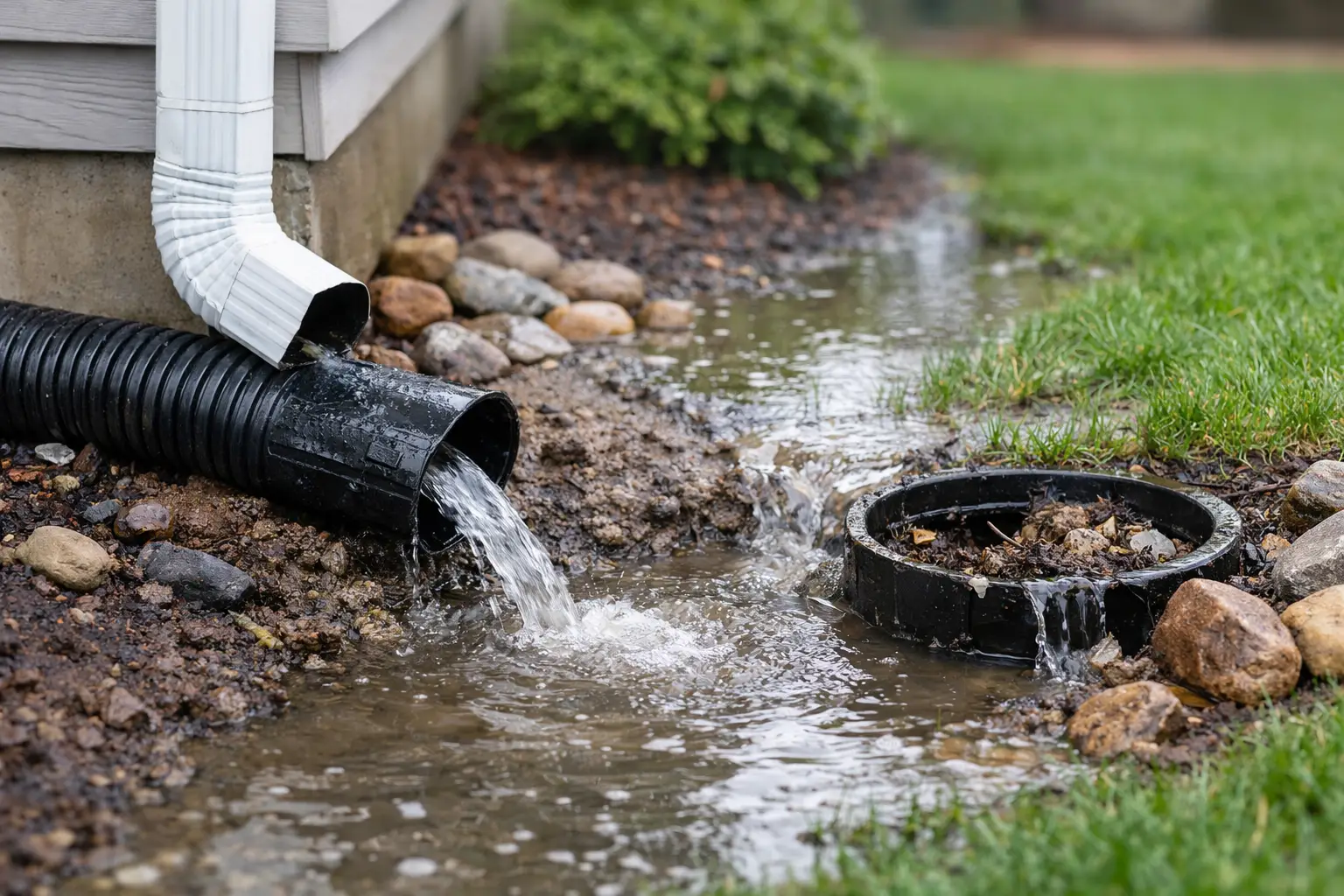
A gutter system can look fine from the ground and still send water exactly where you do not want it. That is what makes downspout drainage problems so frustrating for homeowners in Orlando. During a heavy Florida rain, a small blockage, a bad extension, or the wrong discharge point can quickly turn into pooling water, stained walls, soggy landscaping, and pressure around the foundation.
In many cases, the gutter itself is not the main issue. The water is reaching the downspout, but it is not moving away from the house the way it should. That distinction matters because the fix is often more specific than a simple cleaning. If the downspout drains too close to the home, backs up during storms, or sends water onto hard surfaces that slope back toward the structure, the system is still failing at its job.
What downspout drainage problems usually look like
Most homeowners first notice the symptoms, not the cause. You may see water pouring over the edge of the gutter near a corner, even though the gutter looks intact. You may also notice mulch washing out, small trenches forming in the soil, or standing water near the slab after rain.
Other warning signs are less obvious. Paint can start peeling near exterior trim. Wood around fascia or soffit areas may stay damp longer than it should. On homes with recurring drainage issues, you might even see mildew, settlement cracks, or soft ground around the perimeter.
That is why drainage should be evaluated as a full path, not just a single part. Water needs to move from the roof into the gutter, down through the downspout, and safely away from the house. If any part of that path is restricted or poorly planned, trouble shows up fast in Central Florida weather.
Why downspout drainage problems happen
Some drainage issues come from neglect, and some come from design. A downspout can clog with leaves, roof grit, seed pods, and shingle granules over time. In that case, water cannot move through the vertical drop fast enough, especially during a hard storm.
But clogs are only one side of it. A system can also be technically open and still perform badly. Downspouts that empty too close to the home, discharge into low spots, or connect to extensions that have shifted out of place all create the same end result – water collecting where it should not.
Improper pitch can add to the problem. If a gutter run does not direct water efficiently toward the downspout, the outlet gets overwhelmed during peak flow. The same thing happens when a home simply does not have enough downspouts for the roof area it is trying to drain.
Orlando properties also deal with a specific challenge: sudden, intense rainfall. A setup that seems acceptable during light showers can fail badly during a summer storm. That is why drainage needs to be judged by worst-case conditions, not mild weather.
Clogs inside the downspout
This is one of the most common causes and one of the easiest to overlook. Debris often packs tightly at the top elbow or near the bottom where water slows down and catches material. Once that happens, even a partial blockage reduces capacity.
A partial clog can be deceptive because some water still gets through. Homeowners may assume the system is working, while overflow is already damaging fascia boards, siding, or planting beds.
Short discharge distance
If a downspout ends right at the base of the wall, it may be doing little more than relocating the problem from the roofline to the foundation. Water needs enough distance to disperse safely. Without that, repeated saturation can lead to erosion, settlement concerns, and water intrusion risk.
How far is far enough depends on grading, soil conditions, and where the water flows next. There is no one-size-fits-all answer, which is why drainage solutions should be matched to the property instead of copied from the house next door.
Poor grading around the home
Even a clean, properly sized downspout can struggle if the surrounding grade slopes back toward the house. In that case, the downspout may discharge correctly, but the water returns and collects near the structure anyway.
This is a good example of why gutter and drainage issues sometimes overlap with landscaping and grading. Fixing only one part may improve the symptoms without solving the actual problem.
The damage these issues can cause
Water is persistent. If it repeatedly lands in the wrong place, it starts wearing things down. Soil erosion is often the first visible issue. Then come damaged flower beds, displaced gravel, dirty splash marks on siding, and decay in nearby wood components.
The bigger concern is what happens over time. Repeated moisture near the foundation can contribute to movement, cracking, and intrusion. On homes with slab foundations, poor drainage around the perimeter is not something to ignore. On homes with crawl spaces or framed areas, excess moisture can create a different set of problems tied to dampness and wood deterioration.
There is also the gutter system itself. When water backs up due to downspout drainage problems, the extra weight stresses hangers, joints, and fascia attachment points. What starts as a drainage issue can turn into sagging gutters, leaks, and more expensive repairs.
How to tell whether it is a simple fix or a larger system issue
A single clogged elbow is usually a straightforward repair. Once cleared, the system may return to normal if the rest of the layout is sound. The same goes for an extension that slipped off or a splash block that shifted out of place.
The situation is different when the same area keeps failing. If one corner overflows every storm, if water always ponds near the same wall, or if cleaned downspouts clog again quickly, there is likely a broader problem with pitch, capacity, placement, or runoff volume.
That is where a visual check during or right after rainfall can be helpful. You want to see whether water is backing up at the outlet, shooting out too close to the home, or running back toward the slab. The pattern usually tells you a lot.
Fixes that actually match the problem
The right repair depends on the cause. Cleaning is often the first step, but not always the last one. If the downspout is undersized for the roof section, a cleanout alone will not change much during major rain. If the discharge point is wrong, the water will still end up near the house even when flow improves.
Extensions can help when the main issue is distance. Downspout adjustments can help when the angle or placement is sending water into the wrong area. In some cases, adding another downspout improves overall performance by reducing the load on one outlet.
For homes with recurring debris problems, leaf protection may also make sense. It is not a cure-all, and results depend on tree cover and roof design, but it can reduce the amount of material entering the system and lower the frequency of clogs.
When homeowners call Precision K-Gutters about recurring overflow or drainage concerns, the most useful approach is usually direct and simple: find where the water is failing, correct the path, and make sure it drains away from the structure instead of just out of the gutter.
Preventing future downspout drainage problems
Prevention is mostly about routine attention and catching small changes early. Gutters and downspouts should be checked before storm season and after periods of heavy debris fall. Fasteners, elbows, outlet openings, and extensions all deserve a quick look.
It also helps to watch your property after a hard rain once or twice a year. You do not need a technical inspection to notice whether water is pooling near the home or carving channels through the yard. Those signs usually show up before major damage does.
If you manage rental property, regular service matters even more. A drainage issue can go unnoticed for months when no one is paying close attention to exterior runoff. By the time staining, rot, or settlement becomes visible, the repair bill is usually larger than it needed to be.
When to call for professional help
If a downspout is obviously clogged and safely accessible, some homeowners handle basic cleaning on their own. But recurring drainage issues, second-story systems, poor runoff patterns, and signs of foundation exposure are worth a closer look.
Professional service is especially helpful when the problem is not just blockage but layout. The goal is not simply to get water out of the gutter. The goal is to move it away from the home in a controlled, reliable way during the kind of storms Orlando gets every year.
If your gutters are overflowing, the ground near your home stays wet, or one area keeps showing signs of washout, trust what you are seeing. Water rarely fixes itself, and the sooner the drainage path is corrected, the easier it is to protect the home around it.
A good gutter system should be quiet in the background – moving water where it needs to go and giving you one less thing to worry about when the rain starts.